B2B SaaS inbound marketing is how software companies attract, educate, and convert buyers without chasing them. Instead of interrupting people with cold outreach, you create content, systems, and channels that pull the right buyers toward your product at the right time.
For SaaS companies, inbound does two jobs: it drives new users, and it supports retention by keeping customers educated and engaged after signup.
Done well, it compounds over time. A blog post written today can bring in trials two years from now.
This article covers the core strategies, best practices, content formats that work, and how to tie it all back to revenue. If you’re a founder running marketing yourself or a VP trying to scale without adding headcount, this is a practical guide you can act on.
What is inbound marketing in B2B SaaS?
Inbound marketing means creating content and experiences that bring buyers to you. They find you through search, social, or word of mouth. You earn their attention instead of buying it.
In a B2B SaaS context, that looks like blog posts that rank on Google, webinars that teach your ICP something useful, and email sequences that guide a trial user toward paying. The buyer moves at their own pace. Your job is to be useful at every stage.
Contrast this with outbound, where you push messages out. Cold email, SDR outreach, and SDR calls are outbound. They can work, but they stop the moment you stop paying or dialing.
Inbound is different. A well-ranked guide or a sharp email nurture sequence keeps working after you build it. That is the core appeal for SaaS companies with limited marketing resources.
The inbound model maps well to how SaaS buyers actually behave. They research before they talk to anyone. They read reviews, compare tools, and try products before they pull out a card. Inbound meets them during that research phase, before they have made a decision.
| Inbound | Outbound |
| Buyer finds you | You find the buyer |
| Compounds over time | Stops when you stop |
| Builds trust before the ask | Interrupts to make the ask |
| Blog, SEO, email nurture | Cold email, cold calls, SDR outreach |
Why is B2B inbound marketing important for SaaS companies?
B2B inbound marketing for SaaS companies solves a problem most teams face eventually: how do you grow without burning runway on channels that stop working the moment you stop paying?
Three reasons stand out:
It compounds. Outbound effort is linear. You get back what you put in, and no more. Inbound compounds. A piece of content that ranks builds traffic month after month. An email sequence that converts well keeps converting. The ROI of inbound improves over time in a way that outbound rarely does.
It builds trust before the sales conversation. B2B SaaS buyers are skeptical. They have been burned by tools that did not deliver. A company that teaches them something useful before asking for money earns a different level of trust than one that cold-pitches on LinkedIn.
It costs less per acquired user at scale. Outbound has high variable costs. Every new contact requires effort. Inbound assets get cheaper per user as they mature. According to research cited by HubSpot, inbound marketing costs 62% less per contact than traditional outbound methods. For SaaS companies watching their marketing budget, that matters.
None of this means inbound replaces paid. The best SaaS marketing teams run both. But inbound gives you an asset base that does not switch off when the budget runs dry.
When to partner with a B2B SaaS inbound marketing agency
Inbound marketing takes time and skill. Most SaaS teams hit one of three walls.
#1. No bandwidth. The founder is running PPC, writing copy, managing onboarding, and fielding sales calls. There is no one to own inbound consistently.
#2. No specialist knowledge. Inbound marketing for B2B SaaS inbound marketing is not the same as inbound for e-commerce or local services. SaaS has longer buying cycles, product-led growth dynamics, and unit economics that change what good looks like. A generalist agency will not have this context.
#3. Scaling faster than the team can handle. When you have PMF and a budget to grow, the constraint is often execution capacity. An agency fills that gap without the overhead of a full-time hire.
This is where a specialist B2B SaaS inbound marketing agency adds real value. Not just execution, but the domain knowledge to point effort at the right things. Camel Digital, for example, works with PLG SaaS companies specifically. The focus on trial-to-paid, desktop user quality, and unit economics is built into how campaigns and content are planned. That specificity matters when you are spending real money and need results, not reports.
The right time to bring in an agency is when you have PMF, a clear ICP, and enough budget to run campaigns and content with intent. Before that, focus on nailing the product and the message yourself.

Proven B2B SaaS inbound marketing strategies
These are the approaches that consistently work for SaaS companies with product-market fit and a growth target.
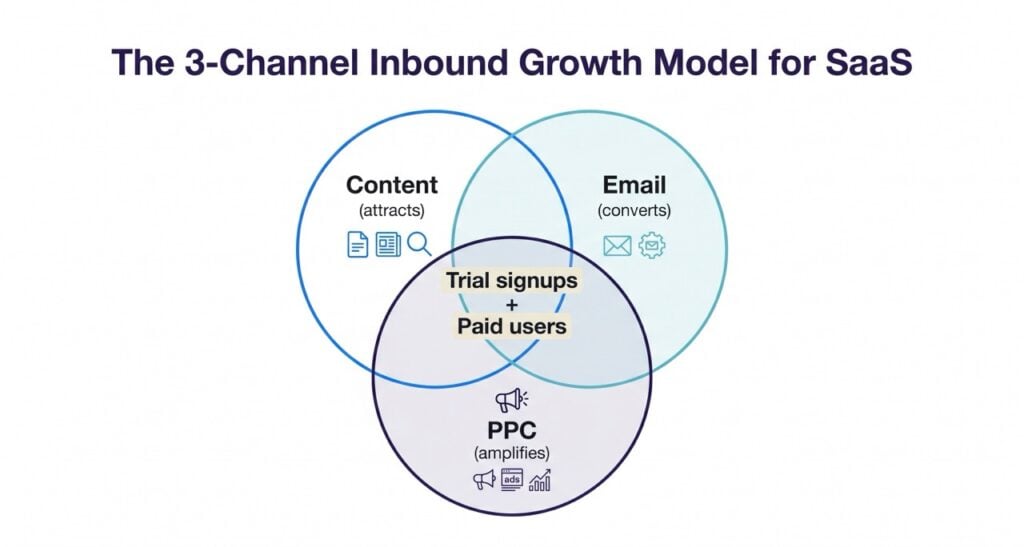
Content creation for B2B SaaS inbound marketing
Content is the engine of inbound. But volume without strategy is a waste of time.
The SaaS companies that get results from content are not the ones publishing most often. They are the ones writing for a specific person with a specific problem.
Start with your ICP. What are they searching for before they know your product exists? What questions do they have at each stage of the buying journey? Build your content calendar around those questions, not around what you want to talk about.
The content you build your inbound program around determines the quality of user you attract, not just the volume. One PLG SaaS client we worked with had two content angles pulling in very different buyers. One content type attracted users with an LTV of $250. Another brought in users with an LTV of $40.
Same product, very different outcomes depending on what the content attracted. Volume looked fine. Unit economics told a different story.
For PLG SaaS founders, useful content lives in three categories:
- Problem-aware content that ranks for pain-point searches;
- Comparison content that captures buyers who are already evaluating tools;
- And activation content that helps trial users get value faster.
SEO-driven blog posts and long-form guides are the backbone. But they only work if they match search intent, cover the topic properly, and lead somewhere. Every piece of content should have a clear next step. A CTA to a trial, a related guide, or a case study.
Content promotion through email and social channels
Creating content is half the job. Getting it in front of the right people is the other half.
Email is the most reliable distribution channel for B2B SaaS. A well-built list of trial users, free plan users, and past leads is an asset. Regular emails that share useful content keep your product in mind during the consideration period. They also give you a way to test messaging before spending money on ads.
Nurture sequences deserve more attention than most SaaS teams give them. A new trial user who gets a well-timed email about a feature they have not discovered yet is more likely to activate. Activation drives trial-to-paid. Trial-to-paid is what matters.
Most SaaS teams set up three onboarding emails and call it a nurture sequence. That is not enough. A trial user who gets a well-timed email about the one feature that drives activation is more likely to pay.
Social distribution, particularly LinkedIn for B2B, works best when it teaches rather than promotes. Share a lesson from a case study. Break down a framework. Show something that happened in a real account. That kind of content earns shares and builds an audience. Promotional posts about your product rarely do.
The goal is multi-channel consistency. A prospect might find you via a blog post, see a LinkedIn post a week later, and then get an email. Each touchpoint reinforces the same message. That is how inbound builds trust over time.
PPC advertising as support for inbound growth
PPC and inbound are not competitors. They work best together.
Inbound takes time to build. A blog post does not rank on day one. An email list does not appear overnight. PPC fills the gap in the short term and amplifies what is already working in the long term.
Retargeting is the clearest example. Someone reads your guide on SaaS lead generation tips, leaves without converting, and then sees a targeted ad for your product or a related piece of content. That sequence moves people down the funnel faster than inbound alone.
PPC also captures demand that inbound has not yet reached. For high-intent searches like “email marketing software,” Google serves four ads first, then AI overviews, then organic results. Ranking third organically often means sitting eighth on the page. Paid puts you in the top four, for the keywords where buyers are closest to a decision. That is coverage inbound alone cannot give you.
The important thing is to measure both channels against the same outcomes. Trial signups. Credit card adds. Paid conversions. Not clicks, not impressions, not traffic. The SaaS marketing funnel works when every channel points toward the same conversion events.
Best practices for B2B SaaS inbound marketing
These are the habits that separate inbound programs that compound from ones that stall. Most SaaS teams do a few of these. The ones that scale do all of them consistently.
1. Define and continuously refine your ICP and buyer journey
Most SaaS inbound programs underperform because the ICP is too broad. The founder wrote ‘small business owners’ and called it a day. That is not an ICP. That is a guess.
Get specific. Who is the buyer? What is their job title, company size, and budget? What pain are they in right now? What does success look like to them in 90 days? Write that down. Then build your content around that person.
Revisit it every quarter. Your ICP shifts as your product matures. The content that worked when you were early-stage may not work when you are scaling.
2. Build a conversion-focused website
Traffic without conversion is just a vanity metric. Every page on your site should have a job. The homepage earns attention and pushes toward a trial or demo. The blog earns search traffic and pushes toward related content or a signup. The pricing page removes doubt and pushes toward a decision.
Above the fold, lead with outcome. Who is this for, what do they get, and why should they believe you. Proof close to the CTA. One clear next step per page.
3. Create authoritative, SEO-driven content
Search is still the highest-intent inbound channel for B2B SaaS. A buyer searching “time tracking software for field teams” knows they have a problem and are looking for a solution. That is a warm signal.
Build content that matches search intent at every stage. Awareness content for problem-aware searches. Comparison content for buyers evaluating options. Bottom-of-funnel content for buyers close to a decision.
Depth matters. A 2,000-word guide that actually answers the question outranks a 500-word post every time. Quality and intent alignment beat publishing frequency.
4. Use email nurture sequences to guide prospects
Most trial users do not convert on day one. They sign up, poke around, and leave. A well-built nurture sequence brings them back.
Map the sequence to the activation journey. What does a user need to do to get value from your product? Build emails that guide them toward those moments. A user who activates is far more likely to pay. A user who pays is far more likely to stay.
For prospects who have not signed up yet, nurture sequences build familiarity over time. Consistent, useful emails keep you top of mind until they are ready to buy.
5. Leverage social channels for distribution and engagement
LinkedIn is the primary social channel for B2B SaaS. But it works differently than most teams expect.
Promotional content gets ignored. Educational content gets shared. Break down a framework. Share a counterintuitive finding from your data. Tell the story behind a result. That is the content that builds an audience and drives inbound traffic.
- If you want a model for how to structure posts, Jasmin Alic on LinkedIn is worth studying. His framework follows a clear pattern: hook (stop the scroll), rehook (deepen the curiosity), value (the actual teaching), and ask (a soft CTA or question). Most posts that perform well follow some version of this. The hook does the most work. If the first line does not earn the second, nothing else matters.
A post that teaches one sharp thing, told through a real example, will outperform five posts that promote your product. The goal is to be the person in your niche who actually explains how things work, not the one who says they work.
Consistency matters more than virality. Showing up with useful content every week builds more trust than one big post every few months.
6. Track performance with clear KPIs and analytics
If you cannot tell which blog post drove a trial signup last month, you are flying blind. Inbound without clean tracking is just publishing.
You need to know which content is driving trials, which emails are moving users toward activation, and which channels are contributing to paid conversions.
Set up GA4 properly. Track signups, credit card adds, and plan purchases as conversion events. Connect ad platforms to your product database where possible. The source of truth is always the product database, not the platform reporting.
Tie content performance back to SaaS ROI. Traffic and rankings are leading indicators. Revenue is the outcome. Report on both, but never celebrate traffic alone.
7. Automate for scale without losing personalization
Marketing automation lets a small team punch above its weight. Email sequences, lead scoring, and behavioral triggers can all run without manual input once they are set up correctly.
The risk is sounding like a robot. Automation that feels generic erodes trust fast. Keep the language human. Segment by behavior, not just by list membership. An email triggered by a specific in-app action will always outperform a generic drip.
8. Build a feedback loop with customers
Your best inbound content ideas come from your customers. What questions do they ask on sales calls? What objections come up before they buy? What did they search for before they found you?
Talk to customers regularly. Read support tickets. Watch session recordings. That raw language is the material for your best content. It is also how you keep your ICP definition sharp over time.
What content formats work best for inbound marketing in B2B SaaS?
Strategy matters. But format matters too. A great topic written in the wrong format reaches fewer people and converts worse than it should.
The best format depends on where the buyer is in their journey and how they prefer to consume information. Test across formats. Double down on what works for your audience.
Blog Posts and Thought Leadership Articles
Blog posts are the foundation of B2B SaaS inbound marketing. They drive organic search traffic, build authority, and give you something to distribute across every other channel.
Short posts work for narrow, high-intent keywords. Long-form guides work for competitive, high-value topics where depth signals expertise. Both have a place.
Thought leadership articles, where a founder or senior team member shares a perspective or hard-won insight, do something different. They build personal brands and trust in a way that SEO content alone cannot. The best SaaS content programs mix both.
Webinars and Virtual Training Sessions
Webinars are one of the highest-converting formats in B2B SaaS. A live session that teaches your ICP something genuinely useful generates warm leads who have already spent 45 minutes with you.
They also work for product adoption. A training webinar that helps trial users get value faster improves activation rates. Better activation means better trial-to-paid. That compounds directly into revenue.
Record every webinar. The recording becomes a gated asset, a YouTube video, a blog post, and a clip for LinkedIn. One session, multiple content outputs.
E-Books and Long-Form Guides
Gated long-form content works for capturing contact details from buyers who are in research mode but not ready to trial yet. An e-book on a topic your ICP cares about gives them a reason to share their email.
The key is making it genuinely useful. A thin e-book that just promotes your product will not convert and will not be shared. A dense, practical guide that solves a real problem will.
Use these assets in paid campaigns too. A LinkedIn ad driving to a gated guide targeting VP Marketing titles at 25-75 person SaaS companies is a focused, measurable lead gen play that supports inbound without replacing it.
Case Studies and Customer Success Stories
Case studies are the highest-trust content format in B2B SaaS. A prospect who reads that you helped a company just like theirs get a specific result is far closer to buying than one who only read your homepage.
The best case studies are specific. Not “we helped a SaaS company grow.” But “Hopper HQ: 647 new credit card trials in 3 months. 233% ROAS in 60 days.”
Names, numbers, and the mechanism that drove the result.
Use them at the bottom of the funnel. Link to them from blog posts. Reference them in email sequences. Put them near every CTA. Proof close to the ask always lifts conversion.
Infographics and Visual Content
Complex data and multi-step processes are easier to understand as visuals than as paragraphs. For B2B SaaS, infographics work well for explaining how a product works, breaking down a framework, or summarizing research findings.
They are also highly shareable. A well-designed infographic gets linked to and shared in ways that a standard blog post rarely does. That earns backlinks and expands reach without additional content creation effort.
Among the best content formats for inbound marketing B2B SaaS companies use, visual content is often underinvested. It takes more production effort upfront but tends to earn outsized distribution.
How to measure inbound marketing ROI in a B2B SaaS business
Inbound marketing is an investment. To justify it and improve it, you need to measure the right things.
Start with the metrics that connect directly to revenue.
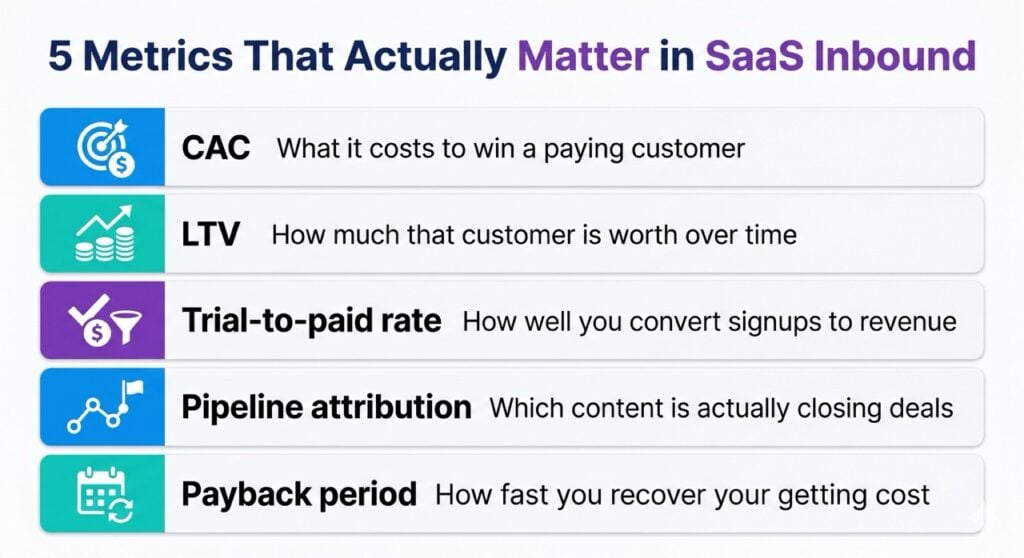
Customer Acquisition Cost (CAC). What does it cost to acquire a paying customer through inbound channels? Track this separately from paid. Inbound CAC should improve over time as your content library matures.
Lifetime Value (LTV). Does inbound traffic convert into high-LTV customers or low-LTV ones? This matters more than volume. A channel that brings in 100 trial users with a $40 LTV is worth less than one that brings in 20 with a $250 LTV. The ROI math only works when you track quality, not just quantity.
Trial-to-paid conversion rate. Of the users who sign up through inbound channels, what percentage convert to paid? If this is low, the problem may be traffic quality, onboarding, or product-market fit. Diagnose before you scale.
Pipeline attribution. For sales-assisted SaaS, which content touches are appearing in the journeys of deals that close? This tells you what content is actually influencing revenue, not just generating traffic.
Payback period. How many months does it take to recover the cost of acquiring an inbound customer? For most SaaS companies, under 10 months is the target. Under 6 is healthy.
Avoid reporting on traffic, impressions, and social engagement as primary KPIs. These are leading indicators at best. They tell you something is working, but not whether it is working for your business. Always connect the data back to trial signups, paid conversions, and revenue.
For SaaS teams thinking about how to allocate spend across inbound and paid channels, the SaaS marketing budget framework is worth working through before committing to a channel mix.
Putting B2B SaaS inbound marketing into action
Inbound marketing is not a campaign. It is an ongoing system.
The companies that get the most from it are the ones that treat it that way. They publish consistently, iterate based on data, and keep their ICP definition sharp as the product and market evolve.
The compounding effect is real, but it takes time. Month one looks like low traffic and no conversions. Month six looks like a growing organic baseline. Month eighteen looks like a reliable acquisition channel that costs less per user than anything else you are running.
That trajectory requires patience. It also requires honesty. If month three looks flat, the answer is rarely to publish more. It is usually to go back to the ICP, tighten the targeting, and cut what is not converting. Inbound that compound is built on iteration, not volume.
Start with one channel done well. A blog that ranks for the right keywords. A nurture sequence that activates trial users. One case study that closes deals. Build from there.
Start narrow. One keyword cluster you can own. One nurture sequence mapped to your activation moment. One case study with real numbers. The foundation has to be right before the volume makes sense. Scale before that and you are spending more to learn less.
The SaaS companies that scale efficiently are rarely the ones with the biggest budgets. They are the ones with the clearest ICP, the most useful content, and the discipline to measure what actually matters.
If you are at the stage where inbound is working but PPC for SaaS could accelerate it, or where CAC is climbing and you need a specialist to diagnose why, that is when it makes sense to talk to a SaaS PPC agency that understands both sides of the growth equation.

FAQs
What is B2B inbound marketing?
B2B inbound marketing is the practice of attracting business buyers through content, search, and educational experiences rather than interrupting them with outbound tactics. Instead of cold outreach, you create assets that pull buyers toward your product when they are actively researching. For SaaS companies, this means blog posts, email sequences, webinars, and case studies that build trust and drive trial signups over time.
What is SaaS B2B marketing?
SaaS B2B marketing is the set of strategies a software company uses to attract, convert, and retain business customers. It spans inbound content, paid advertising, product-led growth tactics, and sales enablement. What makes it different from other B2B marketing is the subscription model. Acquisition is only the start. Retention, activation, and expansion matter just as much to long-term revenue.
What is the difference between B2B SaaS and SaaS?
SaaS, or software as a service, describes any software delivered via subscription over the internet. B2B SaaS specifically refers to software built for business customers rather than individual consumers. The marketing, pricing, and sales motion are different. B2B SaaS buyers involve multiple stakeholders, have longer evaluation cycles, and need to justify ROI to leadership. Consumer SaaS is faster, cheaper, and more impulse-driven.
How to correctly do B2B SaaS product marketing?
Start with a sharp ICP. Know exactly who you are selling to, what pain they are in, and what success looks like for them. Build messaging around that, not around your features. Use content to reach them during their research phase. Use case studies and proof to close the gap between interest and commitment. Track trial-to-paid, not just traffic. And align your marketing and product teams around activation, because getting users to value fast is what turns trials into revenue.