According to Invesp, SaaS inbound marketing generates leads at 62% lower cost than outbound efforts.
This works because inbound matches how SaaS buyers evaluate products: they research independently, compare options, and look for credible proof before engaging with sales.
Inbound supports that process by offering content that answers real questions, demonstrates outcomes, and helps buyers understand how your product fits into their workflow. In regions with growing SaaS ecosystems, inbound marketing for SaaS is becoming a core strategy for educating buyers who prefer self-serve research before engaging with sales.
In 2026, your competitors’ SaaS companies are doubling down on personalized, product-led inbound strategies:
- Behavior-based onboarding flows that nurture users from trial to paid.
- Personalized content based on role, product usage, and intent signals.
- Community programs that improve retention and encourage advocacy.
- In-app education and self-serve onboarding are taking a larger role in activation.
Let’s explore how you can implement these inbound tactics to stay ahead.
What is SaaS inbound marketing?
B2B Inbound marketing for SaaS companies is the strategy where you invite potential customers to your website in exchange for truly valuable content. These could be step-by-step implementation guides, product tutorials, ROI calculators, industry benchmarks, or other resources that help SaaS buyers make smarter decisions.
Instead of relying on broad outreach, inbound earns attention by showing how your product solves real operational pain points.
Unlike traditional marketing, which usually interrupts and pressures with generic reach-out emails or irrelevant offers, inbound marketing for SaaS builds credibility through helpful, data-driven communication. For SaaS buyers, who research deeply before buying, outbound often fails to connect because it lacks personalization and proof of value.
Inbound nurtures these buyers with actionable use cases and performance results that guide them confidently toward adoption.
Why inbound is essential for SaaS growth
Inbound marketing is the backbone of sustainable SaaS growth. When your product runs on a subscription model, success depends on consistent engagement, not one-time transactions.
You don’t just need sign-ups; you need users who stay, upgrade, and advocate. Inbound supports this by continuously educating and guiding users throughout their lifecycle.
Every valuable interaction, from a helpful article to an onboarding email, builds connection and trust that grows over time.
Here’s why B2B SaaS inbound marketing matters:
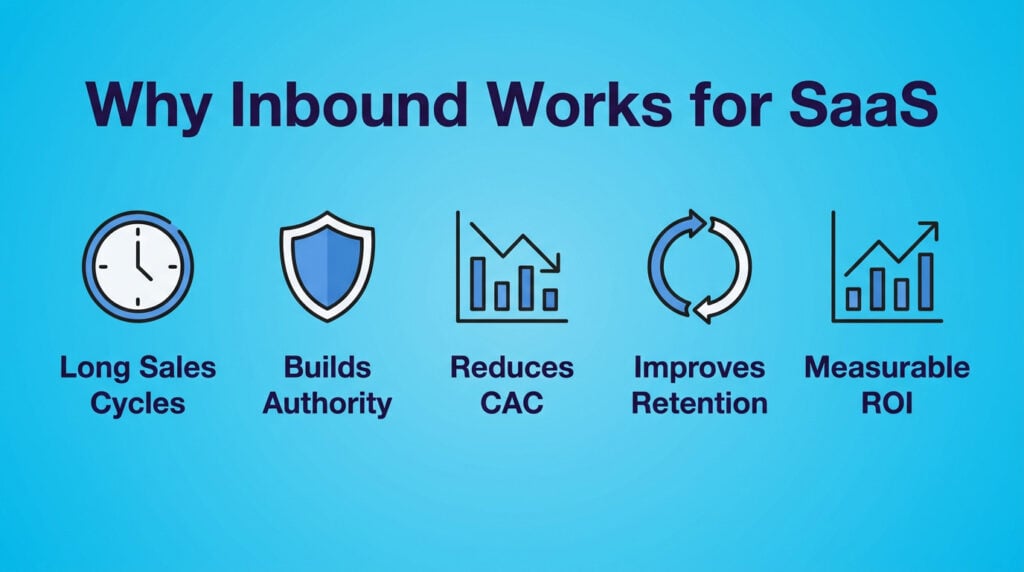
- Nurtures long B2B sales cycles – keeps prospects engaged with content that answers real buying questions.
- Builds lasting authority – helpful educational content positions your brand as an expert, not a salesperson.
- Reduces CAC over time – evergreen blogs, case studies, and webinars keep attracting leads without additional ad spend.
- Strengthens retention – helpful guides, feature updates, and success stories remind customers why they chose you.
- Makes ROI visible – every click, download, and signup is tracked, showing exactly which content drives growth and improves SaaS ROI.
Key components of an inbound strategy for SaaS companies
At every stage of the buying funnel, your audience has different needs, and each stage requires a different kind of signal or final nudge to act.
Recognizing this is key to building a truly effective inbound flow that aligns naturally with how SaaS buyers make decisions.
Every funnel stage requires a different message, format, and intent-driven approach to move prospects seamlessly from awareness to conversion within your SaaS marketing funnel.
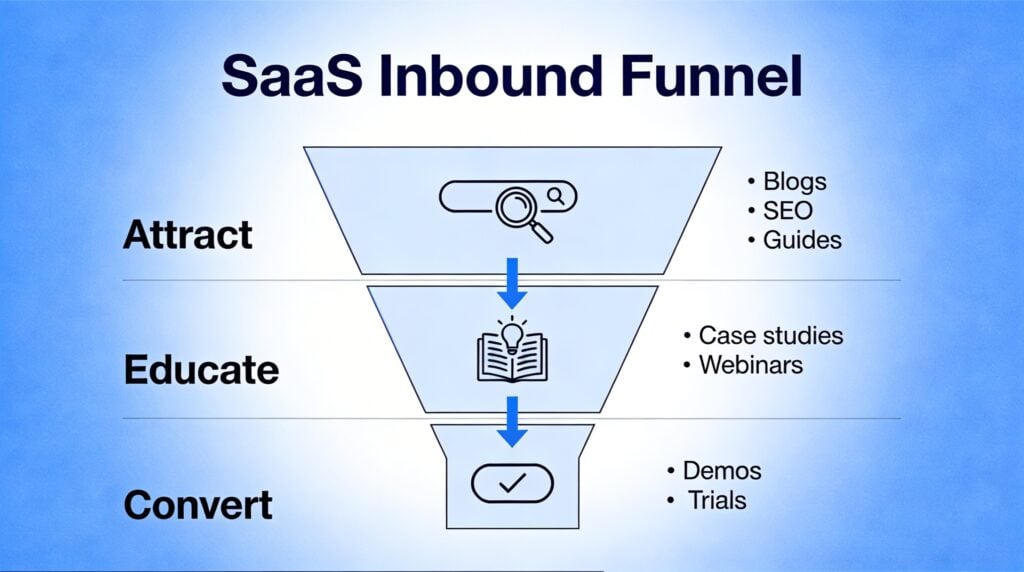
TOFU: Attract with content and SEO
At the top of the funnel, your focus is on visibility and trust-building.
Create educational blog posts, industry insights, and SEO-driven content that meet your audience at the start of their research. Instead of selling, help them understand their challenges and the options for solving them.
When TOFU content provides genuine value, it sets the foundation for stronger brand recall later in the funnel.
MOFU: Educate with case studies and webinars
Middle-of-funnel leads are already aware of their needs. Now they want clarity on why your product is the right fit.
Use in-depth case studies, product comparisons, and webinars that show how your solution fits real-world scenarios. Demonstrate measurable results, best practices, and customer outcomes that reflect your expertise.
The goal is to turn interest into intent by showing that your SaaS isn’t just another tool. It’s a proven solution they can rely on.
BOFU: Convert with demos and free trials
At the bottom of the funnel, prospects are evaluating purchase decisions. They’re actively looking for a SaaS product to buy.
Provide hands-on experiences through demos, free trials, and tailored onboarding sessions that reduce hesitation and show clear value. Support this stage with CRM workflows that deliver personalized follow-ups, helpful resources, and reminders that help guide prospects confidently toward becoming paying customers.
Inbound marketing in 2026: what’s changing?
“AI is making it much easier to get to know your customers better, and it can map the intent of those customers to the information they need, and that means buyers get content that feels personal, contextual, relevant – content that converts.”
Yamini Rangan, CEO of HubSpot (at INBOUND 2025)
If you’re wondering what your number-one goal for B2B SaaS inbound marketing should be in 2026 (and beyond), it’s simple: become more personalized and relevant.
And don’t avoid AI. Use it as a tool to deliver exactly the right content to the right person, at the right time.
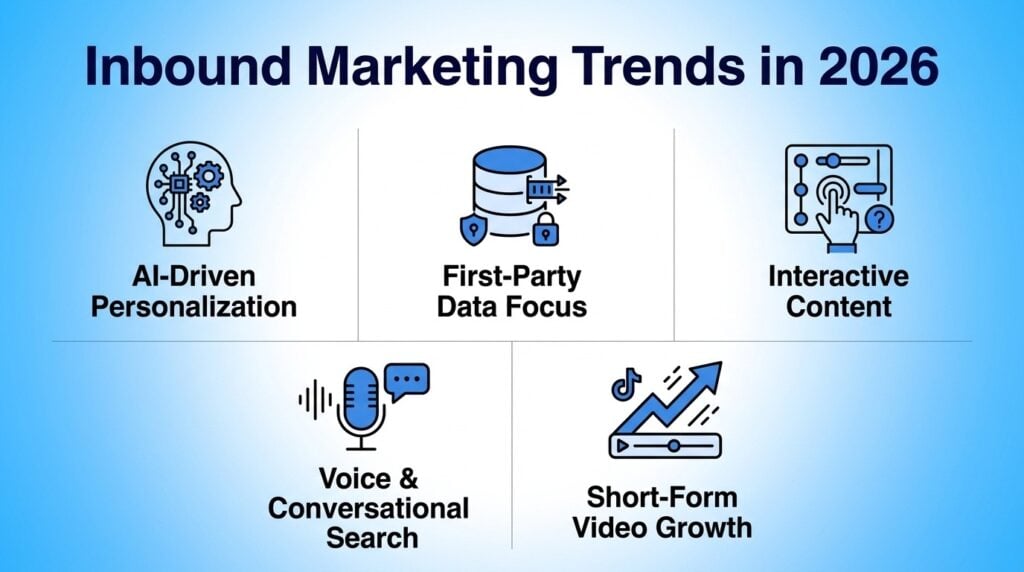
Inbound marketing for SaaS companies in 2026 is evolving into something far more predictive, personalized, and experience-driven. AI-powered automation isn’t just automating tasks anymore; it is anticipating behaviours and dynamically tailoring messages in real-time.
Interactive content like calculators, quizzes, and short videos is replacing static blog posts because it engages users and delivers immediate relevance. With third-party cookies fading, your first-party data becomes the foundation for individualized experiences across channels.
Search behaviours are shifting too: voice queries, conversational prompts, and AI overviews are reshaping SEO. Additionally, short-form video and social commerce are accelerating the direct path from scroll to subscribe.
Some brands are even blending outbound and inbound strategically, targeting key moments in the buyer journey with precision rather than blanket outreach.
In short: if you’re still treating inbound as “blog + SEO + newsletter”, you’re behind. The future of inbound is intelligent, intentional, and deeply human, powered by data, but feels like a one-on-one conversation.
How to build an effective inbound plan for your SaaS company
For over six years, we at Camel Digital have helped SaaS brands attract qualified visitors and turn them into paying users. Along the way, we’ve learned what really works:
- the right content,
- the right audience,
- and the right alignment at every stage of the sales funnel.
Here’s what’s worked for us and what can serve as a strong starting point for your own inbound program.
If you want support implementing these steps or improving inbound performance, our team at Camel Digital can help.
Reach out to Camel Digital today.
Step 1: Define your ICP and their pain points
When we started working with SaaS clients at Camel Digital, one of the biggest mistakes we saw (and made ourselves early on) was assuming everyone who might use the product was part of the target audience. That never works.
Here’s what does.
We always start by identifying the Ideal Customer Profile (ICP), not just by demographics, but by behavior and business context, effectively building a clear inbound marketing persona SaaS teams can use across content, ads, and product messaging.
For example, instead of saying “HR managers,” we narrow it to HR managers in 50–200 employee tech companies who handle payroll manually and report to the CFO. That level of precision changes everything from your ad copy to your landing page examples.
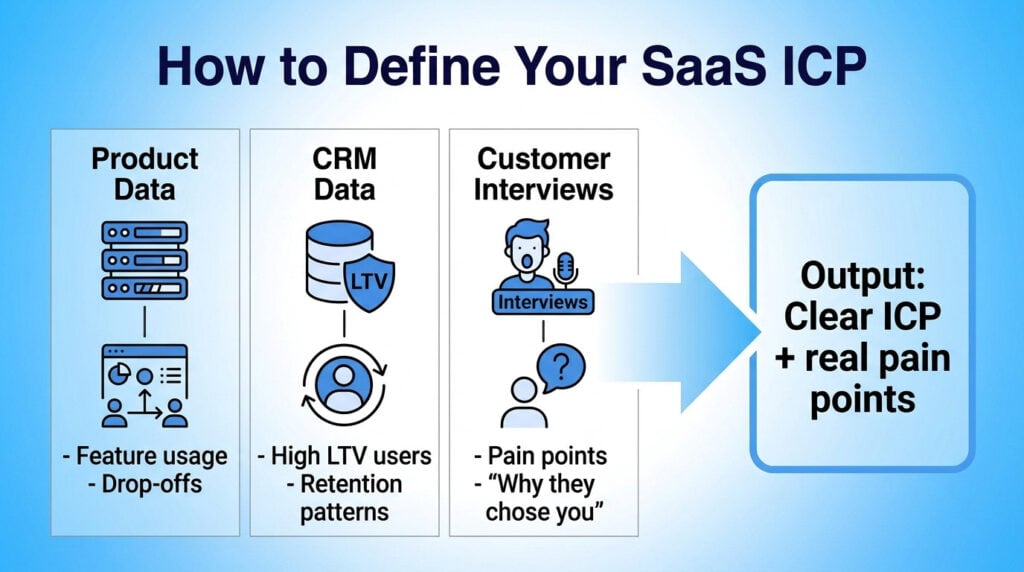
To define it, we combine product analytics, CRM data, and interviews with the most satisfied customers:
- Product analytics: We look at user behavior data to see which features they use most, where they drop off, and what triggers upgrades or cancellations. Tools like Mixpanel or Amplitude show patterns that raw feedback can’t.
- CRM data: We analyze which customer segments bring the most revenue and have the longest retention. HubSpot and Salesforce reports help us spot high-LTV clusters and shared traits across strong accounts.
- Customer interviews: We talk directly with 5-10 of our happiest users. We ask them why they chose the product, what problem it solved, and what “aha moment” made them stay. The language they use often shapes our messaging.
Once we know who they are, we move to why they care.
For SaaS, pain points are rarely emotional; they’re operational. Think wasted hours on manual work, missing integrations, or poor reporting visibility. The goal isn’t to list pains, but to connect each one directly to how your product solves it in real life.
That’s how you stop shouting into the void and start speaking to the exact people who are ready to buy.
Step 2: Create TOFU/MOFU/BOFU content
Every potential customer moves through a different mindset: from learning to comparing to deciding. The sweet spot happens when your content meets them where they are educating first, nurturing second, and proving third.
SaaS buyers are naturally skeptical. They won’t buy because of emotion or urgency alone. They buy when they understand the benefits of your SaaS product.
That’s why educational content is essential at the TOFU (Top of Funnel) stage. Here, we focus on awareness blog posts, how-to guides, SEO-driven articles, explainer videos, or webinars that teach, not sell.
For example, when we worked with an HR SaaS client, a simple “How to Automate Payroll in 2025” guide brought more traffic than any product-focused ad.
At the MOFU (Middle of Funnel) stage, your leads already know what they want; they just need a reason to trust you.
That’s where we offer lead magnets: detailed white papers, ROI calculators, comparison eBooks, or templates that give real value in exchange for contact info. These pieces move prospects from passive readers to engaged leads, and that’s when automation takes over for nurturing.
Finally, at the BOFU (Bottom of Funnel) stage, logic wins over curiosity. Prospects are ready to make a decision, and nothing works better here than social proof.
Case studies, customer testimonials, and data-backed success stories are your strongest conversion tools. Show how similar companies achieved real outcomes using your SaaS and your audience will see themselves in those results.
When you combine all three stages of education, trust, and proof, you don’t just attract leads; you guide them toward becoming loyal customers.
Step 3: Set up CRM workflows
Setting up CRM workflows turns your inbound marketing from a traffic engine into a predictable revenue system. Inbound brings leads, but CRM workflows make sure those leads are tracked, nurtured, and followed up at the right moment.
In SaaS, where buyers often take weeks (or months) to convert, automation ensures that no potential customer slips through the cracks.
At Camel Digital, we use CRM workflows to connect every part of the funnel, from first website visit to product signup and post-trial engagement.
Once your CRM is properly set up, you can see where each lead came from, how engaged they are, and what actions they’ve taken. That means marketing and sales finally work in sync.
Here’s what works best for us:
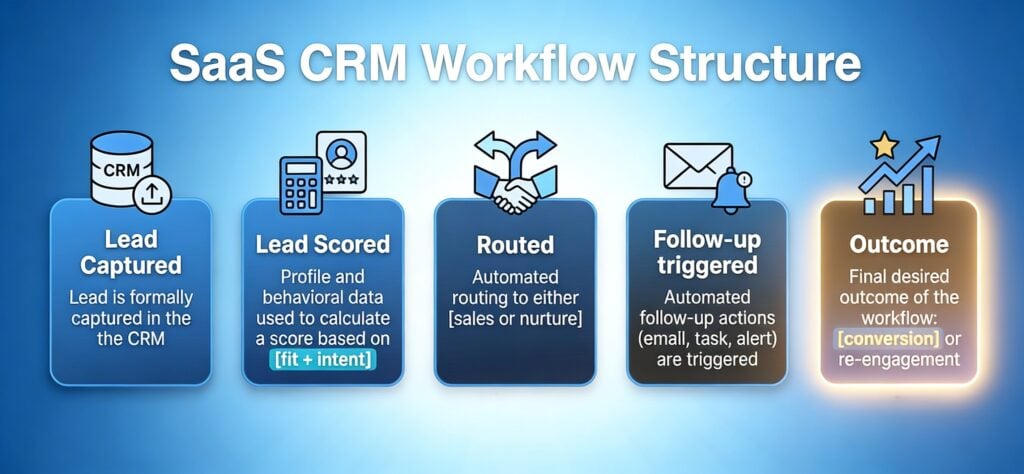
- Automatic lead capture and tracking: Every form, chat, and demo request goes directly into the CRM with full source data (UTMs, campaign, landing page).
- Lead scoring: We score based on fit (ICP match) and intent (behavior such as pricing page visits or trial signups).
- Smart routing: Hot leads (high fit + high intent) are sent to the right sales rep, while others go into automated nurturing sequences.
- Follow-up workflows: Leads that don’t convert get re-engaged through educational emails, reminders, or feature updates tied to their interests.
When done right, your CRM becomes the backbone of inbound, tracking every touchpoint, alerting your team when to act, and keeping your SaaS pipeline healthy, predictable, and data-driven.
Step 4: Distribute (email, social, SEO)
In SaaS, the work doesn’t end when a prospect becomes a customer. In many ways, that’s when the real work begins.
SaaS users are constantly exposed to new tools, features, and pricing models from competitors. They compare, test, and switch faster than almost any other customer type. That’s why consistent communication and nurturing are essential.
Especially for subscription-based models, you’re not only trying to win users once. You’re continually reinforcing to them that staying, upgrading, and renewing is worth it.
For most SaaS brands, three communication channels form the foundation of an effective inbound distribution strategy: email, social media, and SEO. Each serves a different purpose, but together they help maintain connection, trust, and growth.
Email remains the heartbeat of SaaS communication. It’s where you can build personal, consistent, and automated touchpoints. Instead of sending broad product updates, focus on behavior-based drip campaigns that guide users through specific stages like onboarding, adoption, renewal, and reactivation.
For example, when we work with SaaS clients, we set up workflows such as:
- Onboarding sequences: A short email series helping new users explore core features step by step.
- Usage-based triggers: If a user hasn’t logged in for a set number of days, an automated email highlights key use cases they haven’t tried yet.
- Upgrade nudges: When users hit plan limits, send contextual suggestions explaining how an upgrade solves their growing needs.
This turns email into a proactive support tool, not just a marketing channel. The goal is to make every message feel like help, not promotion. Tools like Customer.io, HubSpot, or ConvertKit make it easy to set up personalized flows that respond to behavior in real time.
Social media
Social channels create an ongoing conversation with both prospects and customers. SaaS social marketing should show thought leadership while staying approachable.
We focus on two core tracks:
- Organic presence: Consistent, value-driven content such as short tips, behind-the-scenes updates, customer spotlights, and educational threads on LinkedIn or X (Twitter). For example, sharing “3 lessons we learned scaling our infrastructure to a larger user base” builds credibility and relatability.
- Paid and retargeting campaigns: Target previous website visitors or trial users with helpful content, not just ads. A retargeting video explaining “how to get the most from your free trial” performs far better than a generic “buy now” banner.
Social is also an early-warning system. By tracking engagement and feedback, you can sense what users care about, which is a priceless advantage in fast-changing SaaS markets.
SEO
SEO is the most durable inbound engine for SaaS, but only when treated as a continuous, adaptive process. It’s not about ranking once but owning the search intent behind your audience’s questions.
We focus on three key areas:
- Evergreen educational content: In-depth blog posts and guides that answer the “how” and “why” questions related to your product’s use cases.
- Bottom-funnel optimization: Pages like “{Competitor} vs. {Your Product}” or “Best {Category} Tools for 2026” attract highly-intent buyers ready to decide.
- Ongoing updates: Regularly refreshing older content, optimizing for new search behaviors (voice and conversational queries), and maintaining technical SEO health.
A well-optimized content library keeps working in the background, drawing in readers who are already in problem-solving mode fit for SaaS buyers who rely on research and proof before making decisions.
Step 5: Measure and iterate
No inbound marketing for a SaaS company is complete without understanding what’s working and what isn’t. Inbound marketing for SaaS company growth depends entirely on continuous measurement and iteration.
Every blog post, ad, or email flow should have clear tracking and attribution in place, so you can see how it contributes to sign-ups, activations, and renewals.
At Camel Digital, we build every inbound plan with measurement at its core. We connect analytics tools like Google Analytics 4, HubSpot, and Looker Studio to track traffic quality, lead sources, and conversion journeys across the funnel.
That lets us answer the questions that really matter:
- Which channels bring the most qualified leads?
- Which campaigns lower CAC?
- Where should our SaaS marketing budget go next month?
We review dashboards weekly, run A/B tests, and make small, consistent adjustments that keep performance climbing.
Inbound marketing is never done. It’s an ongoing process of testing, learning, and refining.
At Camel Digital, we measure every outcome and optimize campaigns based on performance data. Contact us for more.
Should you work with an inbound agency?
Choosing the right inbound marketing agency for SaaS can significantly impact how fast your pipeline grows and how efficiently you convert traffic into revenue. If you want a reliable partner to support inbound lead generation for your SaaS product, Camel Digital offers:
- Proven playbook: Over 6+ years of experience running inbound campaigns for SaaS brands, giving us a tested framework of what works in this niche.
- SaaS-only focus: We don’t divide our attention across industries. Every campaign we run adds to our depth in SaaS marketing, strengthening our expertise in the SaaS niche.
- Conversion-first mindset: We focus on the metrics that matter. Everything we design, write, and analyze aims to generate qualified leads and measurable growth.
In-house teams vs outsourcing to agencies
Building an inbound engine for SaaS is about connecting hundreds of moving parts across inbound SaaS marketing strategy, messaging, design, automation, and analytics. Doing this entirely in-house can seem appealing because you stay close to your brand and keep full control. You know your product best, and your internal team can respond quickly to small shifts in positioning or pricing.
But there’s a trade-off.
In-house teams often struggle to keep up with the evolving inbound landscape. New AI tools, SEO updates, and channel algorithms change faster than most companies can adapt.
That’s where partnering with a SaaS marketing agency makes a measurable difference. Agencies that work exclusively in SaaS inbound learn patterns, test hypotheses, and refine what works across multiple clients’ insights that are hard to replicate internally.
A specialized inbound marketing agency for the SaaS team doesn’t just execute tactics; a strong inbound marketing agency SaaS partner brings a system that’s been tested, improved, and validated in real campaigns. They understand the nuances from the tone that resonates with technical buyers to how to structure analytics dashboards that reflect MRR impact instead of vanity metrics.
In other words, while an in-house team knows your product, a seasoned SaaS agency knows the market, and combining both perspectives often leads to stronger, faster growth.

Mistakes to avoid in SaaS inbound marketing
After working with SaaS companies for more than six years, we’ve seen patterns repeat. The same mistakes show up across teams of every size, and avoiding them makes inbound work much faster.
Don’t create fluff content.
SaaS buyers are smart. They don’t need another “10 Tips to Be Productive” blog post. They’re looking for expertise, proof, and data. If your content doesn’t teach, clarify, or solve something real, it’s just noise. This is why experienced SaaS writers for inbound marketing are critical, because they understand how to translate product complexity into clear, decision-driving content.
Don’t ignore the middle and bottom of the funnel.
TOFU content gets attention, but MOFU and BOFU close deals. Blogs get you traffic; case studies, webinars, and product comparisons get you revenue. Don’t stop halfway down the funnel. Many future customers make decisions there.
Don’t treat all leads the same.
Not every signup is ready for a demo tomorrow. Segment by who they are, what they need, and where they are in the journey. The more relevant your message, the less likely they are to ghost you later.
Don’t forget about sales alignment.
Marketing and sales aren’t two separate groups. They’re supposed to orbit the same customer. If your inbound SaaS marketing strategy isn’t aligned with your sales follow-up, great leads will slip away before they ever see your product.
Making inbound work long-term
Now let’s talk about the DOs that make B2B SaaS inbound marketing last. Inbound isn’t a one-time effort; it’s a long-term rhythm that separates the short-term spikes from steady growth.
Do stay consistent.
Inbound momentum builds over time. Keep publishing, keep updating, and keep showing up even when results take a few months to show. Consistency trains both your audience and search engines to trust you.
Do experiments constantly.
Try new formats, new CTAs, and new channels. A/B test subject lines, page layouts, and email sequences. SaaS markets shift fast; your strategy should adapt just as quickly.
Do align with your product and customer success teams.
Marketing shouldn’t operate in isolation. Product teams know the features customers use most; success teams know where users struggle. When all three work together, your SaaS content marketing speaks the same language as your users: authentic, relevant, and data-backed.
Do measure and iterate.
Look at the numbers, listen to the patterns, and adjust accordingly. The best inbound programs evolve weekly.
Making inbound marketing work for you in 2026
We’re not just another agency claiming to “do inbound.” We’re a team that has spent more than six years working closely with SaaS companies, testing, failing, improving, and ultimately building a framework that works.
Our strategies are built around real SaaS buyer behavior, AI-powered analytics, and content that supports users through each step of their decision-making journey.
If you’re ready to scale qualified inbound traffic and shorten sales cycles, we can help you build a program that grows with your product. Contact us at Camel Digital for a personalized consultation.