Content marketing is crowded, so SaaS teams face a tough challenge: breaking through with content that isn’t just noise. Your buyers are sharp, cautious, and slow to commit. They expect value before they ever sign a contract.
That’s why SaaS content marketing in 2026 needs to be focused, product-aware, and built for long-term trust. Done right, it can move prospects through the funnel faster and deliver measurable growth.
What is SaaS Content Marketing in 2026?
Content marketing for SaaS is the practice of creating educational and product-related content that attracts, educates, and converts potential users across the SaaS buying journey.
Why holistic? While an inconsistent content strategy may bring short-term attention, it doesn’t add up to a coherent brand message that helps you stand out in the long run.
Why funnel-aware? Because you work with people at different stages of their purchase journey, your content’s goal is to guide them through the process.
And, why commitment to a long-term relationship? Because your SaaS content marketing strategy faces a unique challenge that many other types of content don’t – it has to convince people to trust you with their data and a crucial part of their operations, and to do so regularly.
Why is SaaS Content Marketing Important?
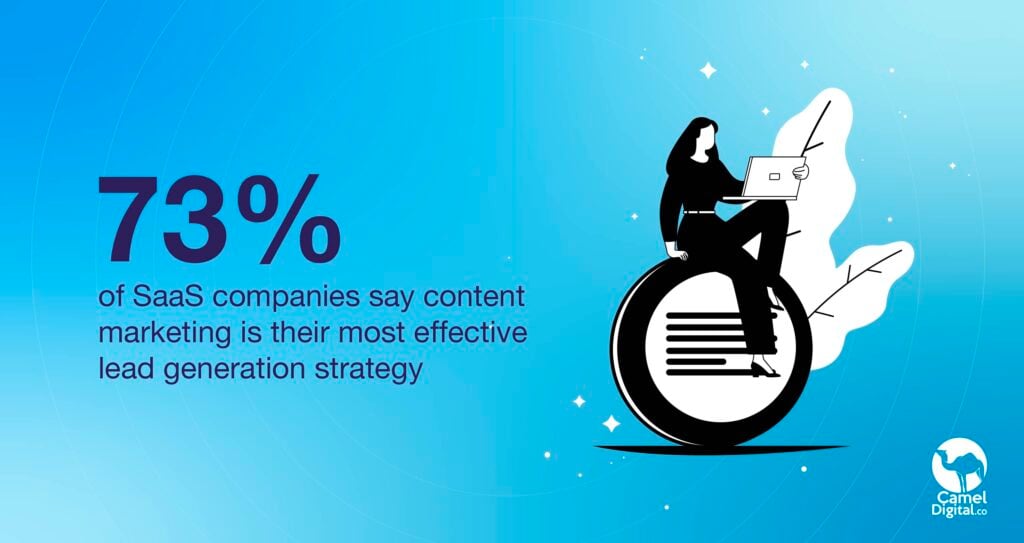
Considering the nature of SaaS customers (longer buying cycles, nuances of decision making), this audience needs deep and convincing information about the product before making a purchase, and content marketing delivers precisely that.
Research from Demand Metric and the Content Marketing Institute shows that content marketing generates more than three times as many leads as outbound marketing while costing about 62% less, making it one of the most efficient ways to attract qualified prospects.
You can achieve a relatively high SaaS content marketing ROI because SaaS customers are typically lifelong learners. They are always seeking new information and ready to allocate their budget whenever they find something valuable. This creates a strong opportunity to use content marketing as a sustainable lead generation strategy.
Turn your content into an educational experience your audience actually uses, and you’ll likely see a measurable increase in leads and conversions.
What Makes SaaS Content Marketing Different from Other Industries?
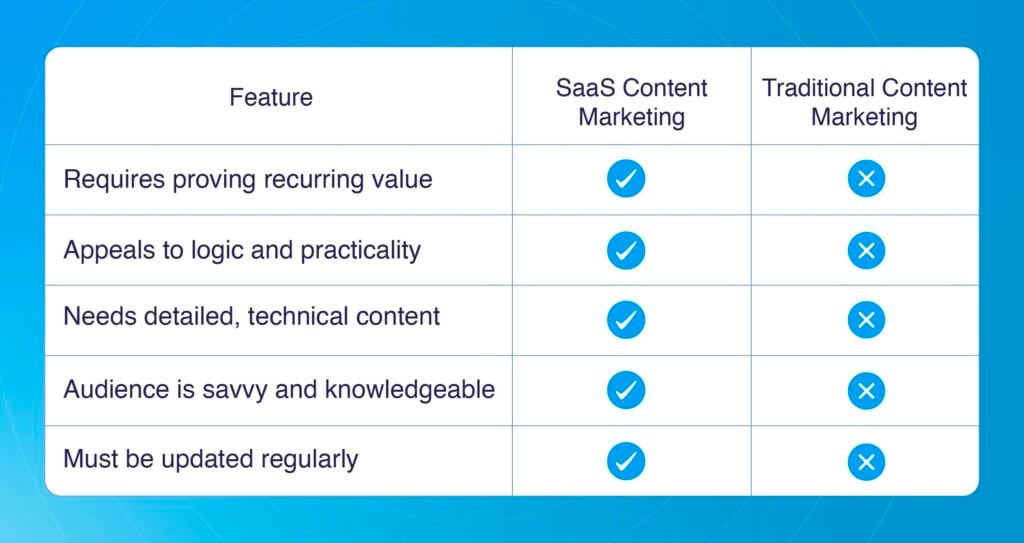
Proving recurring value is the biggest challenge for SaaS companies. You need to convince your audience to pay you once, then again for one more month or year. That’s why SaaS content marketing is different from other industries.
While many industries strive to evoke emotion, B2B SaaS content marketing appeals to logic and practicality. You need to show your audience the value, cost savings, and efficiency of using your product or service.
You need to be detailed and technical.
Demos, tutorials, and case studies are essential components of SaaS content marketing, and they need a high level of detail.
Your target audience is savvy and knowledgeable about their industry, so they’ll appreciate a deep dive into the technical aspects of your product or service.
In addition to being informative, SaaS content marketing must also be consistent and regularly updated. With constantly evolving technology and new competitors entering the market, it’s crucial to stay on top of industry trends and updates to remain relevant.
SaaS content marketing is complex, but it works when executed well.
How To Create SaaS Content by Funnel Stage
Here’s a quick breakdown of what to focus on at each stage of the funnel, with examples of content formats that work best.
- TOFU: attract attention and educate
- MOFU: compare solutions and build trust
- BOFU: prove value and drive decisions
TOFU: Top of Funnel
Focus on broad, general pain points and awareness. Use educational guides, blog posts, and thought-leadership content to attract people who are just starting to explore their problem.
Example: A guide on why automation saves time for small teams.
MOFU: Middle of Funnel
Address solution-aware audiences who are comparing options. Use case studies, tutorials, and product comparisons to show how your solution fits their needs.
Example: A tutorial on setting up workflows with your product to save hours each week.
BOFU: Bottom of Funnel
Target decision-ready buyers who need proof and reassurance. Use demos, ROI calculators, and testimonials to help them confidently choose your product.
Example: A demo showing your product automating tasks and saving specific amounts of time.
How to Create SaaS Content That Converts in 7 Steps
We recorded a 35% increase in lead generation after our blog on Google Ads for SaaS started ranking, and a 54% boost in demo bookings after our case studies went live.
That’s only part of our B2B SaaS content marketing strategy.
Here’s what we now confidently share with you: a working formula based on our own experience and detailed analysis of successful SaaS companies’ content marketing strategies.
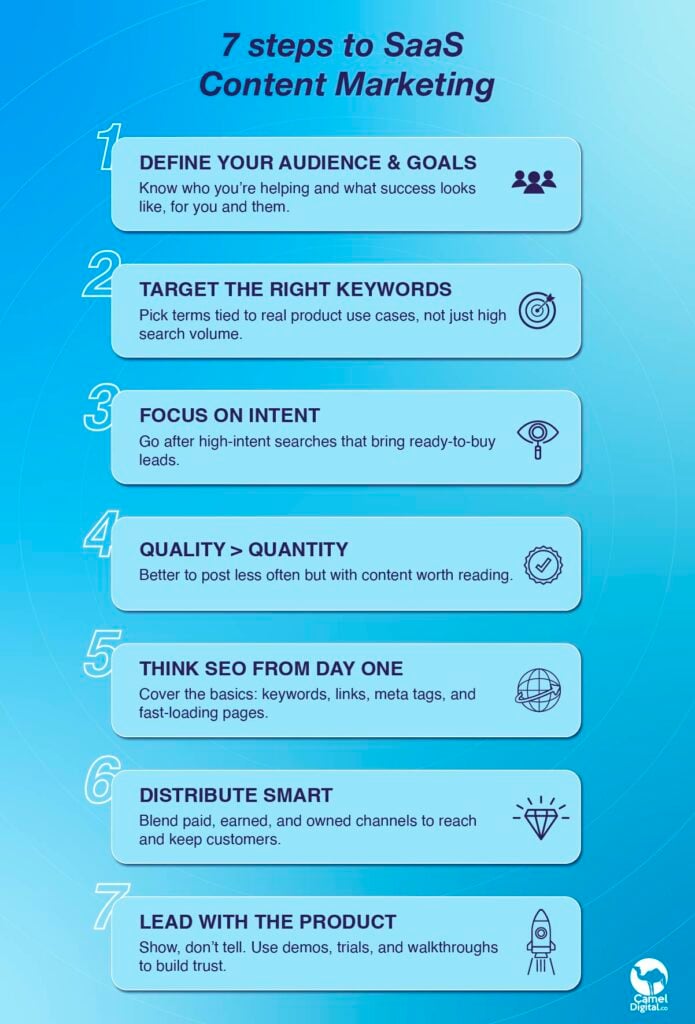
1. Define your business goals and audience clearly
When you know what you want to achieve, you know who you can sell to. And when you know who’s going to benefit from your SaaS, you can define realistic, achievable business goals around them.
Implement these three steps:
1. Analyze the audience you already have. Even if your social media following is small or your demo signups are still in the single digits, talk to the people who’ve shown interest in your product. Research them in detail: What are their pain points? How did they discover your product? Why did they decide to try it?
2. Analyze the audience you want to attract. As a SaaS marketing agency, we focus on reaching SaaS business owners, CEOs, and other decision-makers. We thoroughly study our ideal audience by interviewing them, observing their behavior across online platforms and offline interactions, analyzing their pain points, and brainstorming content that speaks directly to them.
3. Define mutually beneficial business goals. Make sure your goals also serve your audience. For example, if we aim to double our sales by the end of 2026, we set a milestone to improve our services and upgrade our packages – not just for profit, but to make our offer more attractive and competitive for the people we serve.
Example: If you’re a SaaS offering automated reporting for marketing teams, your audience might be growth marketers struggling with manual data exports, and your goal could be reducing reporting time by 50% for teams under 20 people.
2. Build a keyword strategy that aligns with your product use cases
When choosing keywords for your SaaS content marketing, rely on multiple tools, as each tool has its own algorithm for providing keyword data. Once you’ve filtered thousands of possible keywords for your target audience, prioritize the ones that match your product’s specific use cases and create a SaaS keyword strategy.
Quick breakdown:
- High-intent: “best [category] software”, “[tool] pricing”, “[tool] alternatives”
- Mid-intent: “[category] tools comparison”, “how to choose [category] software”
- Low-intent: “what is [category]”, “how does [problem] work”
Example: if you’re choosing between “accounting software” and “small business accounting software,” and the latter is more specific and aligned with your target audience, opt for it. Even if “accounting software” has a higher search volume, it’s a broader term that may attract unqualified leads.
3. Develop a content plan based on intent, not volume
Many SaaS companies opt for high-volume keywords, assuming that more searches translate to more potential leads. However, only an intent-based SaaS content marketing strategy can consistently generate qualified leads.
For example, if your goal is to increase sales, target bottom-of-funnel keywords. These usually have lower search volume but higher conversion rates. It’s better to promote your content to an audience that’s ready to take action than to reach a larger but less committed crowd.
Example: “best CRM for startups” will convert significantly better than “what is CRM”, even if the search volume is lower.
4. Prioritize quality over quantity in your content production
This shouldn’t be an excuse to become inconsistent with your B2B SaaS content marketing strategy.
If you have to choose, focus on creating high-quality content rather than a large volume of mediocre posts.
Balance is key because both irregular publishing and low-quality content can damage your brand reputation and reduce audience engagement.
The balance: Choose a consistent schedule that allows you to maintain your quality standards.
5. Optimize content for SEO from day one
SEO ROI for B2B companies can exceed 700%, and it’s better not to lose even a single percentage point.
Even if you’re not deep into technical SEO, always keep the basics of content optimization in mind. Include relevant keywords and meta descriptions, use internal and external links, and optimize images for search engines.
SEO is a slow but steady process that will ensure your B2B SaaS content marketing delivers results over time.
Optimized content consistently drives relevant traffic to your site, acting as a low-effort, cost-effective way to generate leads and conversions.
At minimum:
- Include your primary keyword in the title and H1
- Use internal links to related content
- Write a clear meta description
- Structure content with H2 and H3 headings
6. Distribute your content across the right channels
Two insights will help you make the right choice between marketing channels:
- With fierce competition in the SaaS market, you must use paid channels alongside free ones.
- The SaaS marketing funnel is unique. Here, conversions often begin in the middle of the funnel, and buyers rely heavily on third-party reviews to make a purchase.
What does this mean for your SaaS content marketing strategy? It means you should heavily invest in paid and earned marketing channels. Owned content alone is often not enough to convert someone who’s still building trust.
SaaS buyers rely on community and peer recommendations, so integrating user-generated content (UGC) into your strategy can strengthen trust. Leverage review sites, social media platforms, and customer testimonials to build trust and credibility.
Also, remember: the SaaS sales funnel is not a one-and-done deal. Making the first sale is only the beginning. When a customer makes the first purchase, you face a second battle – turning first-time users into loyal, repeat customers.
That’s where your owned channels come into play. Use email marketing and social media to stay top-of-mind, share product updates, deliver value, and retain customers (read more about ROAS and customer retention).
In short: Use earned and paid media to acquire customers, and owned media to keep and grow them.
Example: Turn one blog post into a LinkedIn post, a short email newsletter, and a retargeting ad to bring readers back to your site.
7. Use product-led content wherever possible
Maybe not you (yet), but the vast majority of your B2B competitors are already using product-led marketing.
This means shifting the focus from traditional assets, such as whitepapers and static landing pages, to free trials, demos, and interactive content, anything that gives potential customers a better chance to experience your product firsthand.
Product-led marketing isn’t about pushing your product. It’s about offering value upfront, showing real benefits through hands-on experiences.
Case studies, product walkthroughs, “competitor alternatives” blog posts, all of these are great tools to educate your audience, build trust, and reduce friction in the decision-making process.
Here’s what we suggest: Put your traditional SaaS content marketing on pause just for a bit. Instead, bring fresh, interactive content to the forefront. Start with free trial signups, demos, or guided product tours. Then expand into webinars, live workshops, and other formats where your audience can engage directly with your product.
Example: Instead of writing about your reporting features, show a real dashboard with sample data and walk users through how it saves time.

Common SaaS Content Marketing Mistakes to Avoid
If you want to succeed, knowing what not to do is just as important as knowing what to do. That’s why we’re here with the Top 3 mistakes that many SaaS businesses make when it comes to content marketing, wasting money, time, and growth opportunities.
Don’t #1: Chasing traffic instead of relevance
You don’t need traffic that has little to no chance of converting. Yet, that’s where many SaaS companies often fall short. They target high-volume keywords, aiming to attract more visitors, but frequently end up with unqualified traffic that fails to convert.
Not only does this waste your budget on SEO and paid ads, but it also leads to a poor user experience. You attract the wrong audience, people whose needs your product doesn’t meet, and the cracks in your funnel become painfully obvious.
Instead:
Carefully filter your keywords and SaaS content marketing topics to ensure you’re only investing in content that aligns with your product’s value proposition. Identify the topic areas where your offered solution fits naturally, and avoid targeting keywords that are loosely related or too broad to bring in qualified leads.
Don’t #2: Focusing only on TOFU without middle and bottom-funnel content
When your SaaS content marketing is just getting started, it might seem logical to begin with self-introductory, top-of-funnel (TOFU) content. That’s because many SaaS companies believe it’s unrealistic to expect conversions early on and instead aim for “awareness” first.
But here’s what’s often overlooked: a large portion of your potential leads are already problem-aware and actively searching for a solution like yours. By neglecting middle- and bottom-funnel content, you miss the opportunity to reach decision-stage buyers. And you know what? They end up converting with your competitors instead.
Instead:
Maintain a balanced funnel in your B2B SaaS content marketing strategy. Even if you’re just starting, ensure you have content for every stage: awareness, consideration, and decision. In fact, many experts recommend starting with bottom-of-funnel (BOFU) content to capture the low-hanging fruit early. These leads already know what they need – they just need a clear reason to choose you. Why not use that to your advantage?
Don’t #3: Neglecting distribution and promotion
Another common pitfall is creating well-thought-out content and expecting it to be seen on its own without any distribution or promotion efforts. For example, blog articles are published in the website’s blog section and left there, hoping someone discovers them through organic search.
Or social media posts are published without a clear ad strategy to reach the right audience or encourage engagement. This lack of planning and follow-through often results in disappointing outcomes, as the content fails to reach its full potential.
Organic traffic can grow when your content is high-quality and relevant. However, in the fiercely competitive SaaS space, that kind of success is too slow and unpredictable; it takes too long to achieve.
Instead:
From the moment you create content, it’s essential to have a distribution strategy in place. Promote, repurpose, and distribute it through every relevant channel: your website, email marketing, social media, and beyond.
Most importantly, use paid ads to promote your SaaS content to a precisely targeted audience. Platforms like Google Ads allow you to target your potential customers with high precision, making it one of the best ways to increase the ROI of your SaaS content marketing efforts.
How to Measure SaaS Content Marketing Results
There’s a whole lot that happens after you publish your content. Some people go crazy sharing it on social media, while others ignore it completely. Some of your content pieces generate a lot of word of mouth, while others fall flat.
Data will show you what works and what doesn’t, so you can refine your strategy and drive better results over time.
Track traffic and engagement metrics
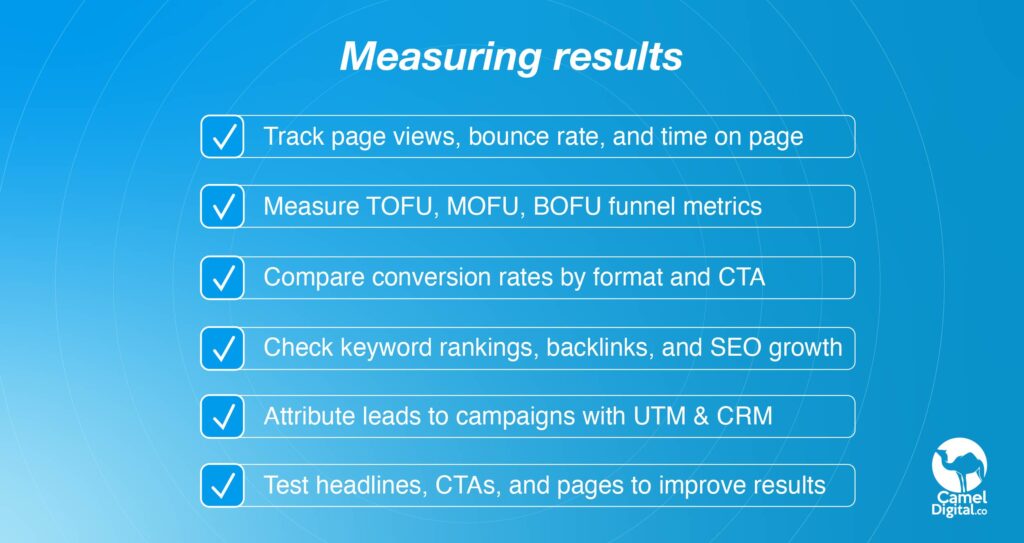
Use Google Analytics as the richest source of data for your website traffic. It can provide valuable insights into how many people are visiting your website, which pages they are viewing, and how long they spend on each page.
By combining data on page views, bounce rate, and time on page with information on the type of content generating the most traffic, you can determine which topics are resonating most with your audience.
Key metrics to watch:
- Traffic: how many people visit
- Engagement: time on page, bounce rate
- Behavior: which pages they move to next
Assess content performance in the sales funnel
Evaluate the results you get for each specific stage of the sales funnel. If that’s the TOFU stage, focus on metrics like page views, bounce rate, and time on page. For the MOFU stage, look into metrics such as click-through rates and conversion rates. Lastly, for the BOFU stage, analyze metrics like lead generation and sales revenue.
To make it more informative, integrate HubSpot or another CRM software that allows you to assign sources and track lead sources throughout the funnel. For example, track how each lead enters the funnel and measure the conversion rate of leads from each source into customers.
Evaluate conversion metrics
When you juggle various content types, it’s very important to track precisely how each of them performs. Your audience might convert better from webinars and be indifferent to ebooks.
That’s why you should make sure to track conversion rates for each specific content type – which channel generates more email signups, form submissions, etc.
Also, pay close attention to which types of CTAs work best for your audience. A/B testing will reveal which type of CTA triggers your audience more – images, text links, buttons, etc.
Examine SEO performance
Any SEO tool you’d prefer will be able to give you detailed analytics about your SEO performance:
- Your domain ranking growth
- Keywords you rank for
- Ranking positions you manage to get
- Backlinks you receive
Though there are thousands of metrics and data points you can track in SEO, your SaaS content marketing can be considered quite good if you record growth in all four points mentioned above.
Here, you must notice when the keywords Google ranks you for start detaching from what you initially expected to rank for. This may indicate that your content strategy is not aligned with the keywords you’re targeting.
Lead quality and attribution
To have the complete picture of your SaaS content marketing ROI, you need to attribute the leads generated by your content to the right marketing channels. This means tracking where your leads come from and measuring how well they convert into paying customers.
One way to do this is by leveraging UTM parameters in your URLs, which can help you identify exactly which marketing campaigns are driving traffic and conversions.
Additionally, use OCT (Offline Conversion Tracking) to track leads that may come from offline sources, such as events or phone calls. By linking these leads back to specific campaigns with the help of a CRM system, you can get a complete and accurate view of your marketing efforts.
A/B Testing and experimentation
If your SaaS content marketing strategy works well, there’s always a way to make it even better. And if it’s stuck, there’s always a way to fix it.
The idea is: you should never stop A/B testing and experimenting with different elements of your content marketing strategy to optimize it for the best results.
Experiment with headlines, CTAs, landing page copy, email subject lines, design elements – anything that can impact your target audience’s engagement and conversion rates. Trust us, you will get valuable insights and data that will help you refine your strategy and achieve better results.
Example: Test “Start free trial” vs “Get started” on your CTA, or compare a long-form landing page against a shorter version.

Making SaaS Content Marketing Work
Less promotion and marketing, more value and education, that’s the formula for successful SaaS content marketing in 2026.
Approach your content creation efforts as a means to share the most valuable information and insights with your target audience, rather than relying on traditional sales pitches.
And when you’re sure you’ve published the right content on your website or social media, make sure it’s served to the audience that’s looking for just that!
At Camel Digital, we help SaaS companies with precisely targeted Google Ads campaigns that have generatedm 233% ROI in two months and increase demo booking by 191%.
Since we’re tightly focused on SaaS companies only, our team knows this niche inside out – with all the best practices and clever tactics that deliver results.
If you want to scale this with Google Ads, we can help. Contact us today.