As a SaaS PPC agency, we look at SaaS ads differently than most people.
When an ad pops up on our feed, we don’t focus on whether it’s creative, impressive, or clever. We try to figure out who it is meant for, what it is promising, and what problem it is trying to correct.
The best SaaS ad is the one that solves a problem so cleanly the user can’t ignore it. It’s straightforward, calls out the pain point instantly, and gets the product’s main value across directly.
In this article, we’re breaking down…
- The best SaaS ad examples we’ve seen
- Why they work
- What you can apply to your own campaigns
What Are SaaS Ads?
When we talk about SaaS ads, we mean everything from paid search and paid social to retargeting and in-product promos that push the next step. Think of Google Ads for SaaS as a carefully targeted promise that moves someone from “this might be interesting” to “this could actually fix my problem.”
An effective SaaS ad isn’t selling a feature list. It’s selling the outcome of using the software.
Imagine an ad showing a marketer what it feels like to ditch five different tools and suddenly manage their whole campaign in one dashboard. That feeling of relief is what we are selling.
Because SaaS ads promote subscription products, they have a higher bar compared to one-time purchase products:
- They must demonstrate ongoing value quickly and convincingly
- They need to stand up to heavy skepticism
- They need to showcase that prospects have already tried competitor tools that failed
The best ones cut through the noise by being hyper-specific, showing the product in action, and offering a pathway to measurable, long-term ROI. That’s where we make the most of every dollar of our ad spend.
SaaS Ad Best Practices
The ad world has shifted to automation, so we’re not manually searching for the audience like before. What matters now is the quality of the inputs sent to the platform, including accurate data, reliable conversion tracking, and clear ad creatives.
And here are the best ways to guide the algorithms.
- Running ads with a clear goal: We design every campaign around a clear outcome, such as booking a demo or starting a trial, then work backwards to the keywords, audience, and creative that move people there with the least friction.
High-intent search terms and problem-focused messaging still drive the best leads, even as platforms lean more into automation. - Giving clear audience signals: We provide first-party data, such as customer lists through the Conversion API, to help platforms better identify users who are more likely to convert.
This approach allows platforms to prioritize more relevant users and improve overall efficiency across SaaS campaigns and SaaS ROI. - Straight to the point tone of voice: SaaS buyers are highly skeptical. Your ad copy must move beyond features and immediately promise a tangible outcome.
For example, instead of “Advanced Reporting Dashboard,” it’d work better to say “Close Your Books 10 Days Faster.” - Testing continuously: The best way to craft a perfect SaaS ad is to test several versions until you find the best one. We keep messages short, focus on one pain point and one promise per ad, and rotate new angles often: problem, desired outcome, social proof, and simple product demos.
Then we judge success on pipeline metrics like qualified demos, sales-accepted leads, and payback period, not only CPC or CTR. - Advertising for different funnel stages: We start with TOFU, using Meta Advantage+ for prospecting with educational and value-driven video creative. The goal is to build a high-quality retargeting audience.
And when we move to BOFU, we use Performance Max to capture high-intent users searching on Google. Ads here push for the clear next step: Free Trial, Demo Request, or Compare Plans.

Top SaaS Ad Examples of 2026
Here are some of the SaaS ads that caught our eye for how clearly they spoke to their users and how well they performed.
We have also included a few campaigns we managed ourselves to illustrate what strong performance looks like in practice.
SaaS Facebook Ads
SaaS Facebook ads are tricky because you’re talking to a broad audience that didn’t come looking for your product. You are interrupting a highly personal scroll, which is why a good ad here must feel native, almost like a friend’s post.
When an ad stops the scroll and brings qualified users at a steady cost, that’s when you know it’s working.
Hopper HQ
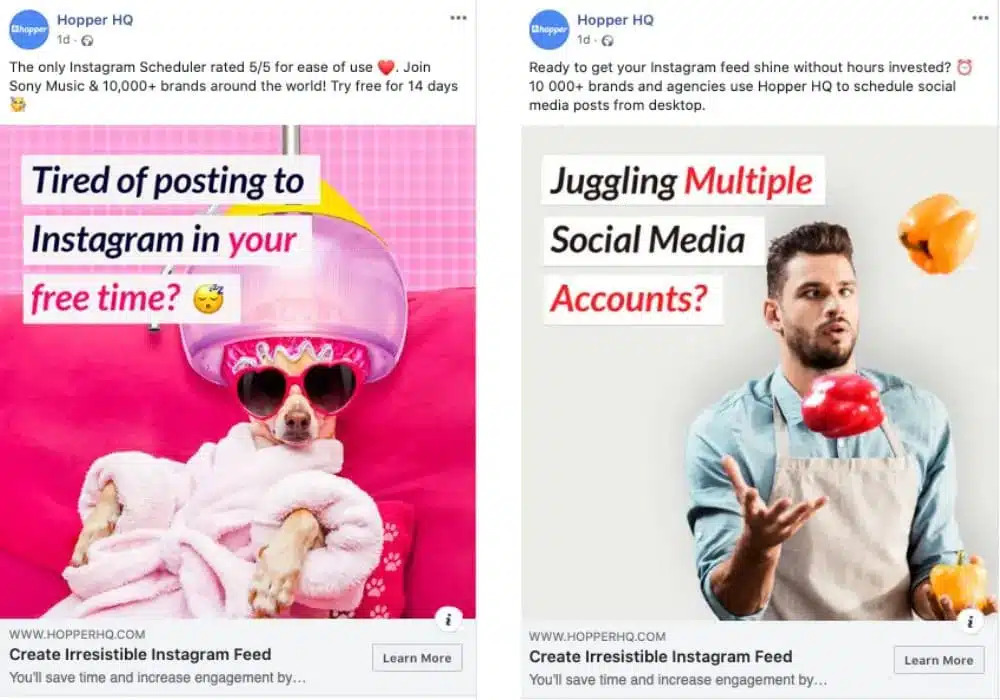
- Ad type: Pain-point-driven, built around attention-grabbing visuals and simple, emotional messaging.
- Platform: Facebook
- Visual breakdown: The creative uses bold, unexpected imagery paired with large, high-contrast text blocks. The hook is the contrast: something playful or exaggerated visually, paired with a very real pain point.
- Messaging hook: Both variants highlight frustration – losing personal time to posting or juggling too many accounts. The ad speaks directly to the daily pressure of social media managers and small business owners.
- CTA & offer: A simple “Try Free for 14 days” path with a clear value promise and strong social proof (“10,000+ brands,” “rated 5/5 for ease of use”).
- Why it works: The key insight was data-driven targeting. The creatives were shown to a tightly defined audience rather than broad, untargeted segments. increasing the likelihood that the ads reached users more likely to convert and retain. This strategy successfully cut the trial cost by 69.57%.
Artlist.io
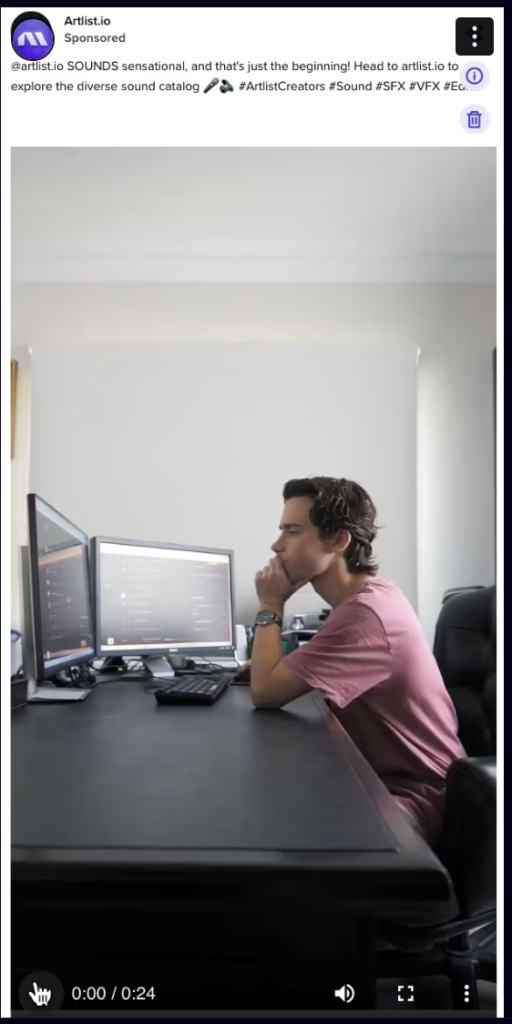
- Ad type: Product-demo-style video ad focused on showing the editing workflow and the creative experience.
- Platform: Facebook/Meta (optimized for vertical video on Reels/Feed).
- Visual breakdown: The video uses a calm, observational setup, showing a creator browsing sounds on dual monitors. The hook comes from the mood: slow pacing, real workspace, authentic editing flow. The entire look is lo-fi and unpolished; it’s meant to look like organic content or a “day in the life” post. The lack of polished branding or sales graphics is intentional, making the ad feel authentic and native to the platform.
- Messaging hook: The copy pushes discovery: “explore the diverse sound catalog.” It speaks directly to editors and creators who constantly search for new, high-quality audio.
- CTA & offer: A soft invitation to “Head to artlist.io,” supported by creator-focused hashtags. No aggressive offer, just a clear path to explore.
- Why it works: It speaks directly to the niche use case (video creation) and targets the emotional reward of finding a massive, reliable resource, reducing the objection of spending time hunting for sound.
SaaS Google Ads
SaaS Google Ads reward clarity and intent. Unlike ads in Meta, we aren’t interrupting a scroll. Here, we are answering a direct question when users search for a similar solution.
The challenge is matching the searcher’s hyper-specific intent with an equally specific, trust-building message in a tiny space. Google ads should match the exact problem users typed.
Monday.com
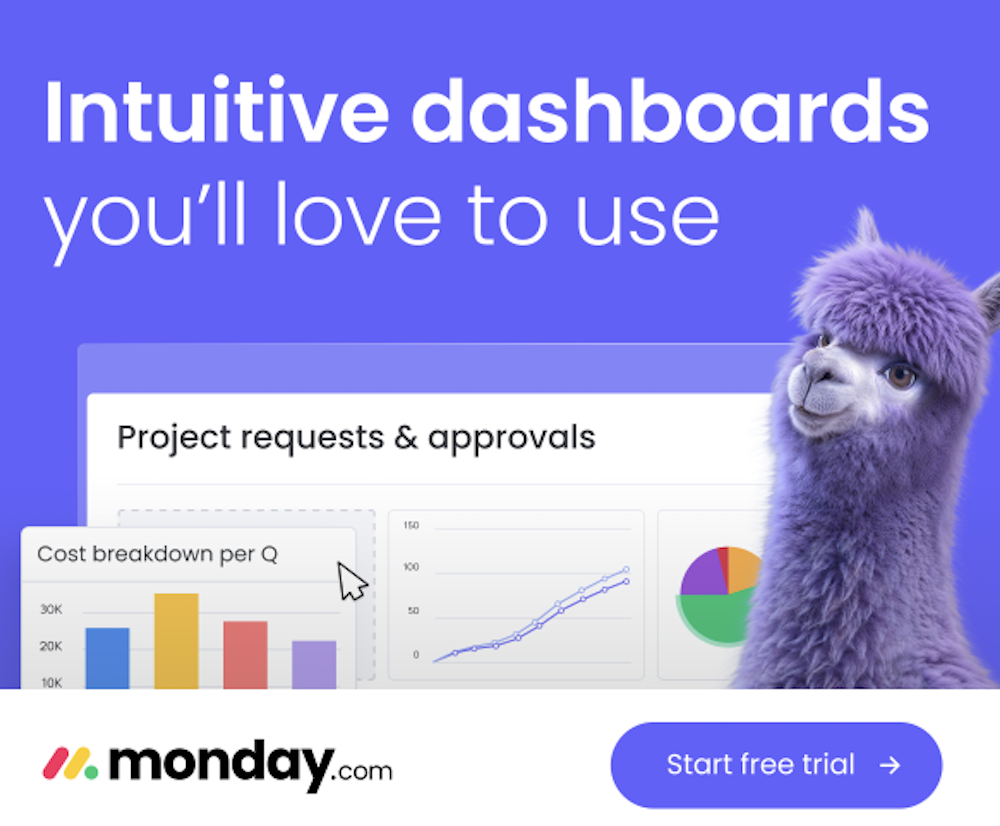
- Ad type: Product-focused Google Display ad highlighting dashboards, UI clarity, and an emotional benefit.
- Platform: Google Display Network
- Visual breakdown: The creative uses bright colors and a playful brand character llama to make project management feel approachable. The UI preview is clean and instantly readable. The layout guides the eye from headline to visuals to CTA without clutter. The hook comes from the friendliness and humour, which is a rare approach in a competitive SaaS category.
- Messaging hook: “Intuitive dashboards you’ll love to use” speaks to ease and enjoyment. It reduces the mental load of trying a new tool and focuses on how the platform feels, not on technical features.
- CTA & offer: “Start free trial” is direct, conversion-oriented, and focuses on a low-friction entry point (a free trial), which is excellent for a SaaS product.
- Why it works: The ad strategically balances simplicity with charm. It highlights the emotional benefit (“love to use”) over just features. The distinctive visual helps the ad stand out and makes a technical product feel more approachable.
Semrush
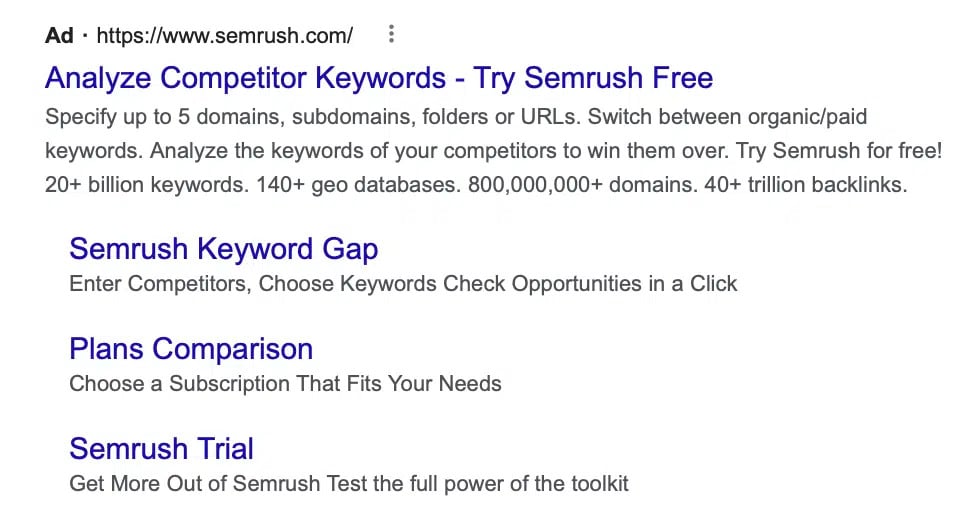
- Ad type: High-intent Google Search ad targeting users researching SEO tools, competitor analysis, and keyword strategy.
- Platform: Google Search (branded + feature-focused queries)
- Messaging hook: “Analyze Competitor Keywords, Try Semrush Free” instantly addresses a core SEO pain point by focusing on competitive advantage. It promises a powerful action and pairs it with a risk-free offer.
The sitelinks are highly conversion-focused, addressing key steps in the user journey: “Semrush Keyword Gap” (a direct feature hook), “Plans Comparison” (for users ready to buy), and “Semrush Trial” (reinforcing the free offer). - CTA & offer: Multiple CTAs through sitelinks (“Plans Comparison,” “Semrush Trial,” “Keyword Gap”). Each path maintains low friction and directs users to pages designed for the next step.
- Why it works: The ad aligns perfectly with high-intent searchers. Strong data points (20+ billion keywords, 140+ geo databases) build authority, while sitelinks capture users across different stages of researching an SEO tool.
SaaS LinkedIn Ads
LinkedIn ads are expensive but powerful.
Unlike the emotional drivers of consumer platforms, success here relies on credibility, direct B2B value, and career aspiration. Ads must speak the specialized language of industry decision-makers, offering solutions for revenue, efficiency, or professional growth.
Stream Labs
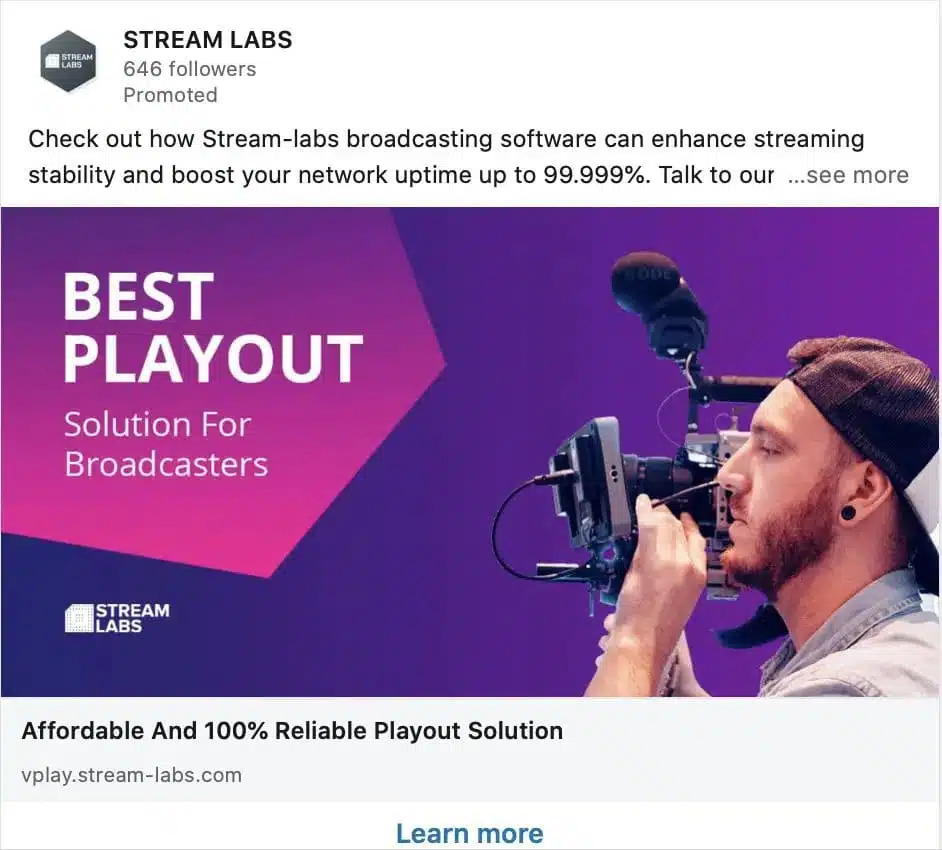
- Ad type: Lead-generation LinkedIn ad promoting a niche B2B SaaS (playout and broadcast monitoring software).
- Platform: LinkedIn (lead gen campaign with native forms)
- Visual breakdown: Bold gradient background, large “BEST PLAYOUT Solution For Broadcasters” headline, and a camera operator in action. The creative instantly signals who this is for and ties the message to a real broadcast context. The brand logo is present but not dominant.
- Messaging hook: The copy focuses on reliability and uptime (“up to 99.999%”), which is a mission-critical metric for broadcasters. It speaks directly to a narrow audience that cares about stability more than anything.
- CTA & offer: “Learn more” driving to a LinkedIn lead form, framed with “Affordable and 100% Reliable Playout Solution.” Low friction, no hard sell.
- Why it works: Precise industry targeting plus clear value propositions cut through LinkedIn’s high CPCs. The ad filtered for serious broadcast professionals and delivered seven high-quality leads in three weeks at approximately 40 percent lower cost.
Gong
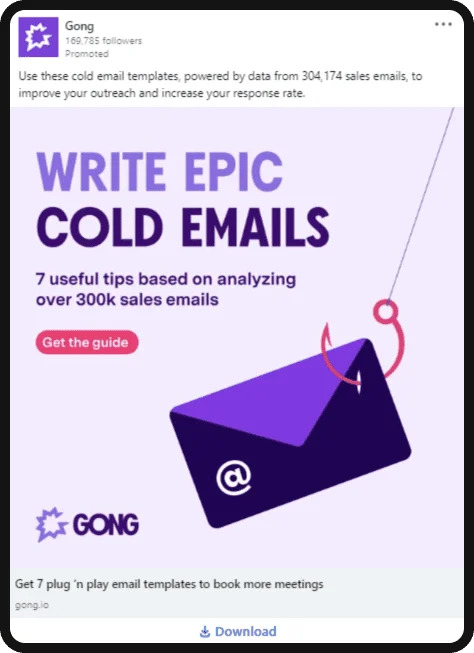
- Ad type: Lead-generation LinkedIn ad promoting a gated guide powered by Gong’s proprietary data.
- Platform: LinkedIn (document download ad)
- Visual breakdown: The creative leans heavily on Gong’s distinctive purple palette and uses a large, simple visual metaphor, an envelope, to signal the topic instantly. The typography is bold and clean, making “WRITE EPIC COLD EMAILS” the first thing the viewer absorbs. Everything about the layout is designed for fast reading on a busy LinkedIn feed.
- Messaging hook: The ad immediately provides the proof point: “7 useful tips based on analyzing over 300k sales emails.” This leverages Gong’s unique data to give the guide credibility. This directly addresses a major sales pain point by focusing on how to get a response from prospects.
- CTA & offer: “Get the guide” / “Download.” Clear, direct, and tied to immediate value. This highly specific number, based on an analysis of 304,174 sales emails, makes the offer feel uniquely valuable and data-driven.
- Why it works: Gong leans on its strongest asset: unique, verifiable sales data. The ad offers a tangible, immediate fix (templates) to a chronic sales problem, making it a compelling, low-friction download for sales professionals on LinkedIn.
SaaS YouTube Ads
SaaS YouTube ads win when they respect attention. Viewers decide in seconds whether to skip, so the opening needs a clear hook, a real problem, or a strong visual pattern break.
The best SaaS YouTube ads teach something fast, show the product in action, and move people toward intent without feeling like an interruption.
- Ad type: YouTube commercial built around miniature set design, stop-motion-style visuals, and product demo moments.
- Platform: YouTube
- Visual breakdown: The animation is highly specific, integrating the monday.com interface directly onto the miniature computer screens, seamlessly linking the physical work world with the digital platform.
The hook is the contrast between a playful, toy-like world and a very real productivity tool. It immediately grabs attention because viewers don’t expect a SaaS company to use model sets instead of digital motion graphics. - Messaging hook: The core message is that Monday.com supports organized work in any atmosphere. The visual metaphor is simple: no matter your work style, chaos level, or environment, monday.com can organize it. The miniature sets symbolize flexibility.
- CTA & offer: The miniature sets are highly memorable and drive brand affinity (fun, modern, creative).
- Why it works: It’s memorable, tactile, and warm, making it a refreshing departure from typical SaaS ads. The handcrafted world makes the product feel human and accessible, while the miniature screens still showcase real interface elements.
SaaS Display Ads
SaaS display ads rely on speed. You only get a split second on a busy page, so the best ones use bold visuals, short promises, and clean UI snapshots to earn attention.
The goal is rapid brand recognition and high-volume traffic through simple, persistent offers like “Start Free” or “Get the Guide.”
Asana
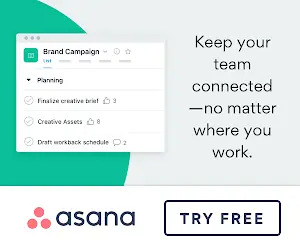
- Ad type: Product-focused display ad highlighting UI clarity and a simple, universal benefit.
- Platform: Google Display Network
- Visual breakdown: The ad features a clean, minimalist design with Asana’s distinctive brand colors. There is a clean split between a crisp Asana task board on the left and a high-contrast headline on the right. The UI preview is intentionally minimal, just enough to communicate structure and organization without overwhelming small display placements.
- Messaging hook: The straightforward text is a broad but powerful promise because it taps into the most common friction point for modern teams: staying aligned. This directly addresses a critical pain point in remote or hybrid work environments.
- CTA & offer: “Try Free” is a standard, low-friction offer for SaaS and works for well mid-funnel evaluators browsing tech content.
- Why it works: The ad works because it’s crystal clear and highly relevant. It communicates value in seconds: recognizable UI, a universal benefit, and a clean CTA.
Adobe
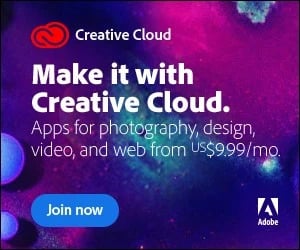
- Ad type: Brand and bundle offer ad. Creative Cloud’s full suite of creative tools with a pricing-focused offer.
- Platform: Google Display Network
- Visual breakdown: The creative is highly visual, featuring a vibrant purple and pink nebula/galaxy background that immediately connects with the concept of creativity and limitless potential. This visual style is itself the hook: it signals creativity before you even read the text. The Adobe and Creative Cloud logos are clearly positioned at the top, ensuring instant brand recognition.
- Messaging hook: There is a simple, command-based headline that speaks directly to the user’s desire to create. It’s short, emotional, and capability-focused. The body copy details the breadth of the offering, reinforcing the all-in-one value proposition.
- CTA & offer: The offer is the specific and highly attractive price point: “from US$9.99/mo” paired with a high-contrast blue button. “Join now” is clear and fits Adobe’s brand tone, which is confident, direct, and aspirational.
- Why it works: The visual identity speaks directly to creatives, while the pricing anchor and wide toolset make the offer feel accessible and high-value. The ad sells possibility, not features.
SaaS Retargeting Ads
SaaS retargeting ads work best when they feel helpful, not pushy. These users already know you, so the goal isn’t to reintroduce the product. It’s to resolve the hesitation they left with.
Personalized messaging (e.g., “Still thinking about it?”) and strong incentives (e.g., limited-time discounts, new feature highlights) are a must here!
HubSpot
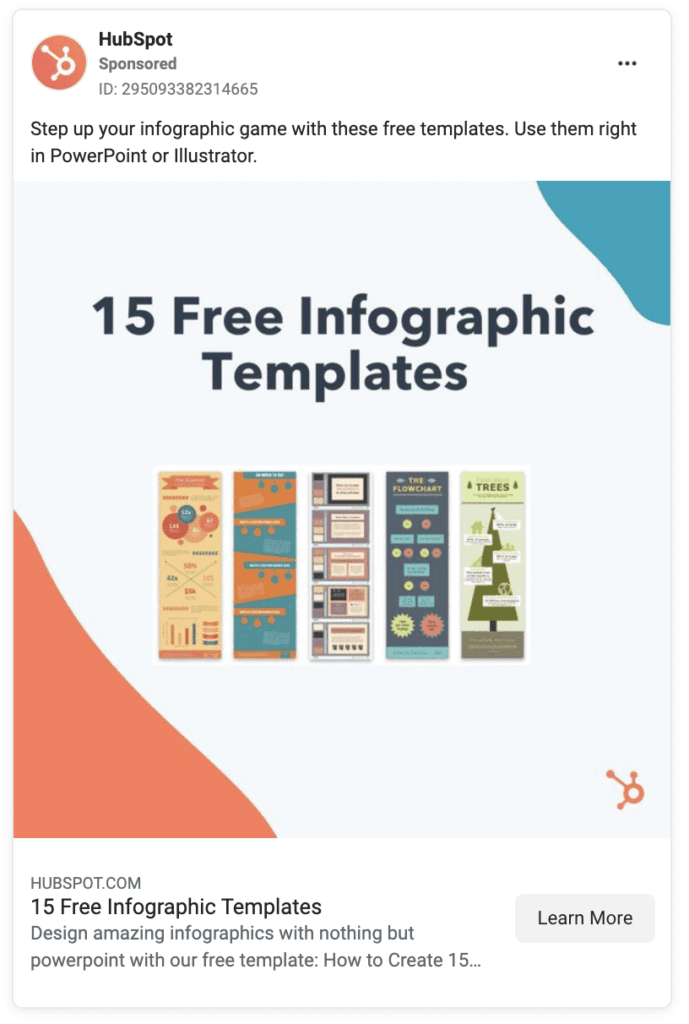
- Ad type: Lead Magnet / Top-of-Funnel Retargeting
- Platform: Social media
- Visual breakdown: The creative is clean and uses HubSpot’s signature orange, blue, and white branding. It prominently displays five distinct infographic designs as a visual proof of the offer’s quality. This immediate visual payoff reinforces the value of the free download.
- Messaging hook: “Step up your infographic game with these free templates.” It promises instant improvement with zero effort. The ad specifically mentions use in PowerPoint or Illustrator, making the tool actionable for the target audience.
- CTA & offer: “Learn More” leading to a free template download, creating a low-risk, high-value re-entry point into HubSpot’s funnel.
- Why it works: It doesn’t sell the complex CRM yet; it nurtures the lead by providing a useful resource. The ad removes all friction by offering a free, practical asset, warming users back up for future nurturing through HubSpot’s content ecosystem.
SE Ranking
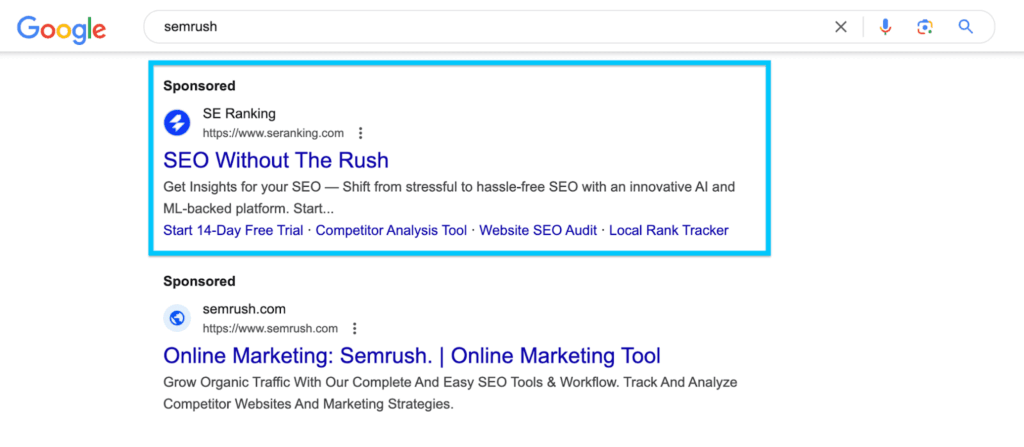
- Ad type: Google Search remarketing ad (RLSA) targeting users who already visited SE Ranking but are now searching for a competitor.
- Platform: Google Search (competitor brand query)
- Visual breakdown: Standard search layout, but the power comes from strong sitelinks and a confident headline. The ad uses a bold headline and the SE Ranking logo to establish immediate brand identity.
- Messaging hook: “SEO without the rush.” This is a clever, direct swipe at the competitor’s name (“Semrush”), implying that SE Ranking offers a less stressful, “hassle-free” experience. This targets a common user pain point with complex software.
- CTA & offer: “Start 14-Day Free Trial” paired with functional links (keyword tools, audits, rank tracking). Each one fits the mindset of someone comparing alternatives.
- Why it works: It converts by leveraging instant, head-to-head comparison. RLSA ensures the ad only appears to warm users, making it more cost-effective and relevant. The messaging softens the pitch and positions SE Ranking as the simpler, smoother choice right when the user is evaluating competitors.
SaaS Native Ads
SaaS native ads work best when they blend into real reading experiences instead of interrupting them. They blur the line between editorial content and advertising, appearing as “Sponsored” articles or recommended stories on high-traffic sites (e.g., Taboola, Outbrain).
The goal is to build trust and capture leads via relevant, non-disruptive content.
Adobe
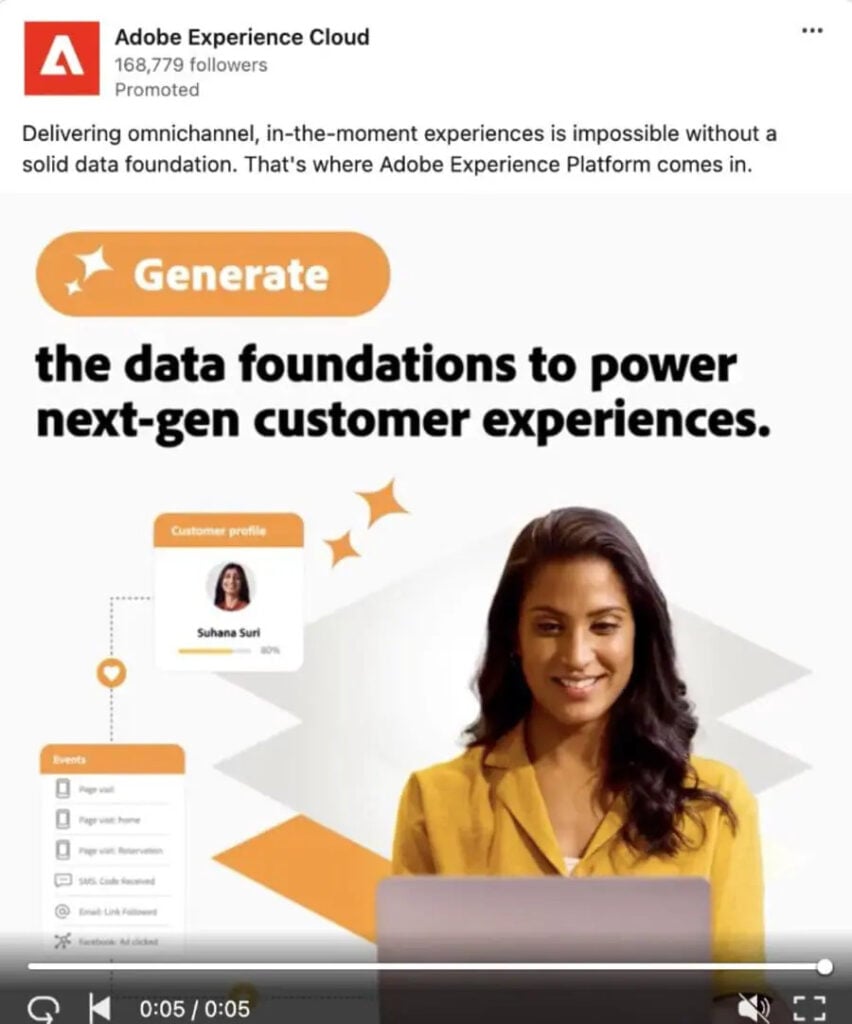
- Ad type: Native in-feed video ad.
- Platform: LinkedIn (native placement blended into the professional feed)
- Visual breakdown: The ad uses professional video production with a friendly, knowledgeable spokesperson. It features bold, actionable text overlays like “Generate the data foundations…” and a graphic showing a “Customer profile” with events and touchpoints, clearly illustrating the product’s function (unifying customer data).
- Messaging hook: This ad speaks directly to C-suite and marketing directors about the strategic necessity of the tool. There is a high-level promise: powering “next-gen customer experiences” through better data.
- CTA & offer: Points users to learn more about Adobe Experience Platform.
- Why it works: Native ads perform when they educate fast. Adobe’s short format, simple visuals, and data-centric framing make the message feel relevant and helpful.
Salesforce

SaaS Podcast Ads
SaaS podcast ads work because they meet listeners in a focused, trusted environment. Instead of fighting for attention, the message becomes part of a story that listeners already chosen to listen to.
This format allows for detailed storytelling and high emotional resonance, which significantly boosts ROAS and customer retention post-conversion.

What Types of Ads Work Best for SaaS?
Great ads don’t happen by accident. They come from understanding how each channel behaves and aligning strategy, messaging, and intent with how that channel performs.
- Search requires matching the user’s intent.
- LinkedIn ads need precision.
- Facebook and Instagram need a clear hook.
- YouTube needs a fast opening that captures attention in the first few seconds.
- Display ads need instant clarity with no fluff.
- Native ads need a story that integrates naturally into the feed.
- Finally, retargeting ads need strong points for reassurance.
If you are unsure how to distribute your ad budget effectively while still generating qualified leads, this is where expert guidance helps.
We have over seven years of experience managing PPC for SaaS companies across multiple growth stages.
Our SaaS marketing agency has seen what drives sustainable growth, what wastes budget, and what continues to scale even in highly competitive markets.
Contact us to discuss your SaaS advertising goals and evaluate where paid channels can drive measurable growth.