If SaaS ads feel harder than they should be, it’s not your imagination. You’re trying to sell something invisible, with a longer buying cycle, to people who rarely convert on the first click. Most of the real work happens after the ad, on the landing page, in the product, and across multiple touchpoints. That’s why flashy ideas and clever copy alone rarely move the needle.
This guide is about creative ad formats for SaaS businesses that actually pull their weight. We’ll walk through formats that consistently support trial signups, demo requests, and real pipeline when paired with the right intent and funnel stage.
More importantly, we’ll show you how to choose the right format based on what the buyer is trying to do, not what channel happens to be trending.
If you’re part of a SaaS team with product market fit and budget in place, and you’re looking for stronger results from paid media, this guide is for you.
What “Best SaaS Ads” Really Means In Practice
When people talk about the best SaaS ads, they often mean the ones that look the most creative or get shared on LinkedIn. In practice, that’s rarely how success is measured.
For companies working in SaaS, “best” usually means something much less glamorous and far more useful: ads that consistently contribute to pipeline and revenue.
Strong SaaS advertising strategies are built around clear, measurable conversion goals. Most SaaS businesses are ultimately optimizing toward one of a few actions:
- Free trial signups
- Demo requests
- Contact sales inquiries
- Lead magnets that turn into MQLs
- Product tour signups
Each of these signals a different level of intent, and good ads respect that. A trial ad should feel very different from a top-of-funnel content offer, and a demo ad should assume the user is already evaluating options.
It’s also worth zooming out. Even though short-term conversions are important, retention and lifetime value matter more.
Ads that attract the wrong buyers might look efficient on the surface, but they tend to break down later in the funnel.
The most effective SaaS ads bring in people who are actually a fit for the product and likely to stick around.
Real World SaaS Ad Examples By Format
High Intent Search Ads
For high intent search ads, one of the clearest real-world examples comes from how many SaaS companies use Google Search to capture demand at the moment of decision.
Take HubSpot’s approach to Google Ads: their campaigns target bottom-funnel keywords related to CRM software and lead generation tools, with copy and sitelinks tailored to navigation paths that align directly with what a buyer is looking for.
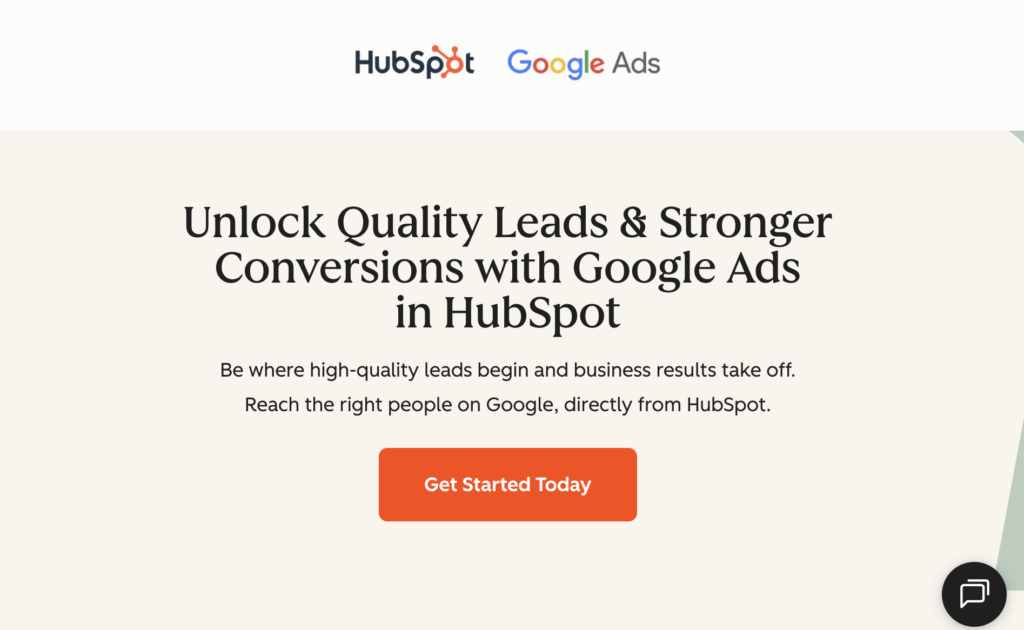
The messaging is direct and outcome-focused, using copy such as “Unlock quality leads & stronger conversions with Google Ads in HubSpot” and “Be where high-quality leads begin, and business results take off.” The intent is clear: this is for teams already searching for ways to drive results from Google Ads, not casual browsers.
What makes this approach work is how tightly the ad promise matches the landing experience. Users searching for CRM software or Google Ads solutions are sent to a focused page that reinforces the same message: reach the right people on Google, track performance end-to-end, and connect ad activity directly to revenue.
Sitelinks and secondary CTAs guide evaluation paths like getting started, learning about lead syncing, or accessing a practical implementation guide, instead of forcing a single action too early.
What to learn: Google Ads for SaaS work best when intent is explicit, messaging is consistent from keyword to landing page, and the path to conversion is short and clearly aligned with the buyer’s evaluation stage.
Competitor Comparison Search Ads
A clean, real-world example of competitor comparison search ads comes from Asana’s campaigns targeting queries like “Asana vs ClickUp.” When users search with direct comparison intent, Asana routes that traffic to a dedicated comparison page framed around one clear idea: “The enterprise-ready platform for cross-team work.” The messaging doesn’t attack ClickUp or list every possible feature.
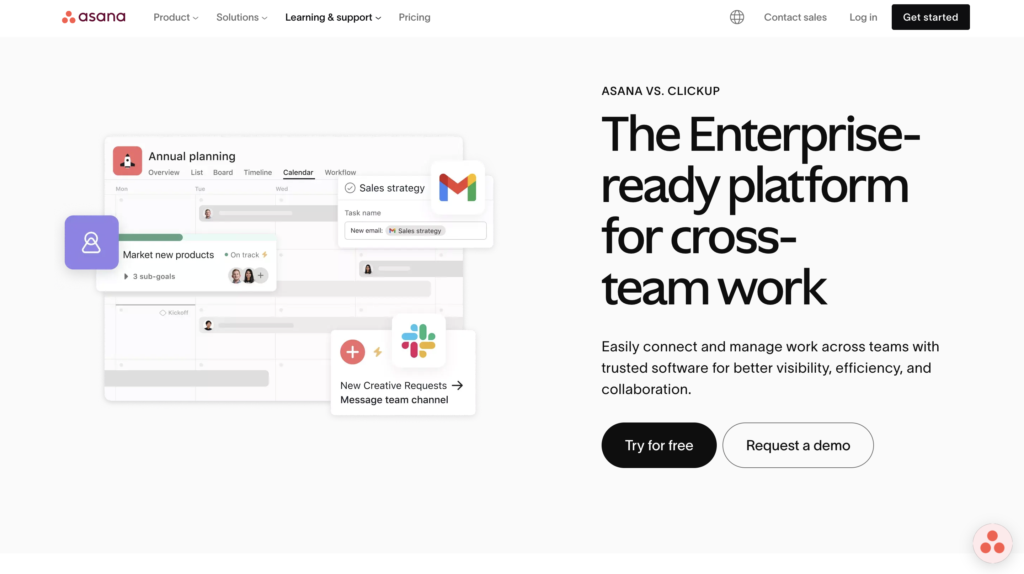
Instead, it positions Asana around ease of use, reliability, and readiness for scale, backed by recognizable customer logos, security standards, and third-party validation.
This works because the ad and landing page respect where the buyer is mentally. Someone searching for a vs query is already shortlisting tools.
Asana meets that moment by narrowing the comparison to a few decision-level concerns: adoption across teams, enterprise reliability, and long-term scalability.
In other words, it doesn’t overwhelm the reader with feature grids upfront.
The CTAs stay aligned with evaluation intent: Try for free or Request a demo, not a hard sell.
What to learn: Competitor comparison ads convert best when they stay focused, acknowledge the buyer’s research, and clearly articulate one or two meaningful differentiators instead of trying to win every feature argument.
Branded Search Protection Ads
When someone searches for a specific product name, like “monday.com,” that’s some of the highest-intent traffic a SaaS brand can capture.
A branded search protection ad doesn’t just defend that traffic from competitors; it reinforces the value proposition and improves conversion rates at the moment someone is closest to choosing a solution.
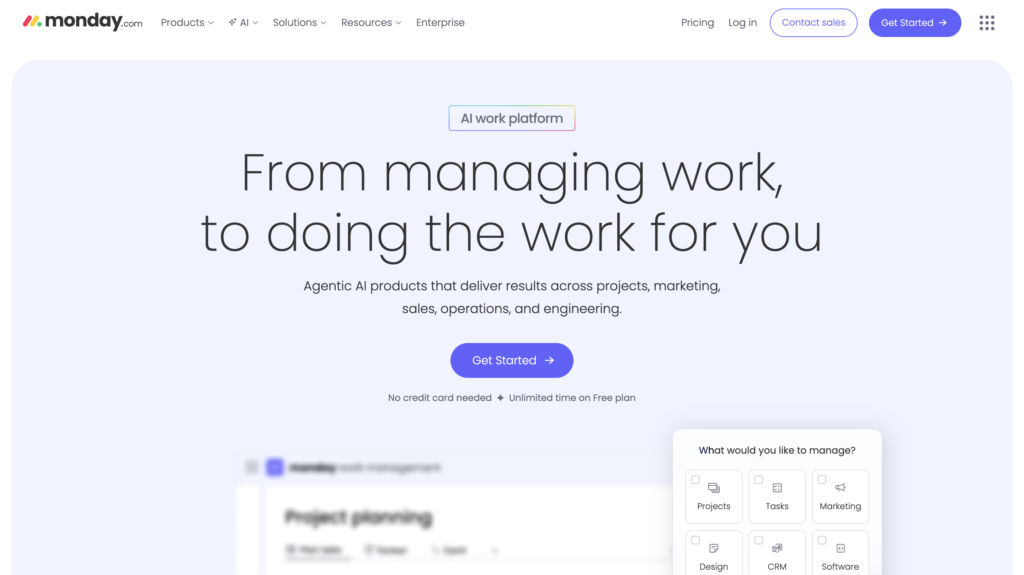
A real example is the search result for “monday.com”, where the ad copy reads: “monday.com Official Site | The Work Platform You’ll Love.”
The headline and description do more than match the brand name. They frame the product as “The Most Lovable Work Platform,” reference social proof (Loved by 245K+ customers), and highlight key paths like pricing, CRM, templates, AI features, and integrations.
That way, rather than simply showing up, the ad starts shaping a positive impression before the visitor even clicks. The sitelinks give multiple paths to conversion, from pricing to specific product modules, making it easier for different buyer intents to find what they need quickly.
This format works because it captures demand already earned. People who already know the brand or are evaluating it get the reinforced trust right at the decision moment.
Instead of just “defending” branded traffic, it nudges users toward the next step with clarity and confidence.
What to learn: Branded search ads aren’t about stopping competitors from bidding; they’re about conversion lift. By aligning ad copy with the product’s core value and offering clear next steps, you take one of the most efficient digital ads for SaaS formats and turn it into a predictable source of qualified traffic.
This is a key pattern in effective SaaS marketing ads, meeting users with context, relevance, and direction at the exact moment they’re ready to act.
LinkedIn Single Image Or Video Ads
HubSpot’s long-running use of LinkedIn ads is a solid example of how this format works when it’s treated as a precision tool, not a broadcast channel. In one documented campaign, HubSpot used LinkedIn ads to promote free educational resources and demos, targeting users by company, job title, job function, and industry.
The ads themselves were straightforward, with clear value statements tied to real pain points like lead generation or SEO performance, and sent users to dedicated landing pages built specifically for that audience and offer.
What’s important here is not whether the ad was a static image or short video, but how tightly the message matched the reader’s role and intent. HubSpot reported clickthrough rates between 1% and 3% on LinkedIn, roughly 60% higher than other social networks they tested, while also seeing higher lead quality and lower average CPC for the segments they prioritized. That combination is why this approach still shows up in many of the best ads for SaaS companies today.
What to learn: LinkedIn ads work when they feel written for a specific professional, not a broad market. For SaaS teams, SaaS video advertising or single-image ads on LinkedIn perform best when they focus on one clear outcome, use precise targeting, and lead to an offer that matches where the buyer is in their evaluation journey.
YouTube Product Explainer Ads
Grammarly is a clear example of how YouTube product explainer ads can work at scale without trying to explain everything at once.
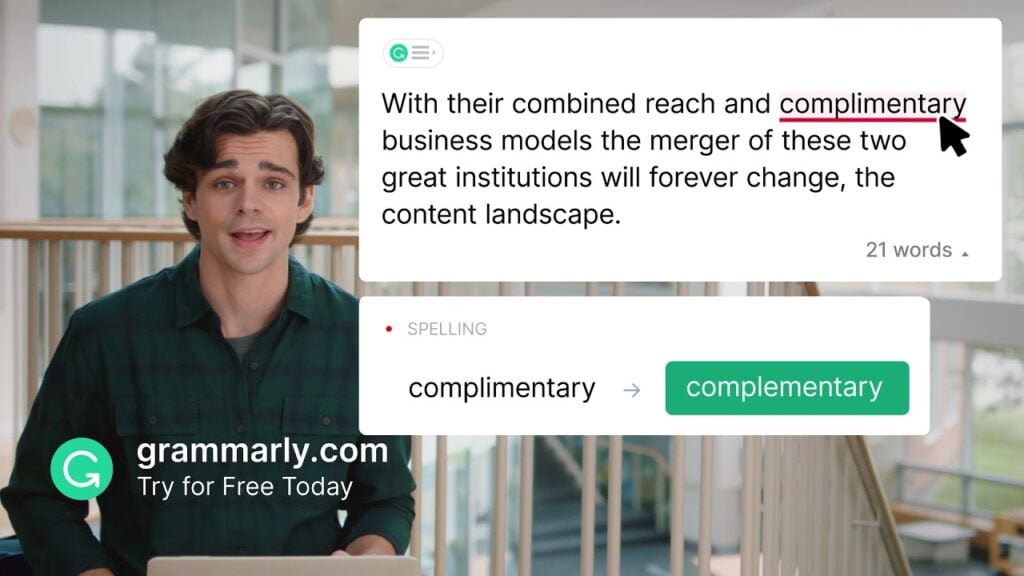
Their short video ads typically focus on a single, relatable moment, a work email that sounds harsher than intended, a document that needs polishing, or a message where tone really matters. Instead of walking through every feature, the video shows Grammarly in use, inside a real workflow, and lands on a simple outcome: clearer communication with less effort.
This approach works because the product is demonstrated in context. Viewers don’t need to imagine how it fits into their day: they can see it.
Grammarly’s ads consistently prioritize outcome over feature depth, which makes them easy to understand in under two minutes and effective for broad reach on YouTube. Those viewers can then be retargeted later with more specific messages once intent is clearer.
What to learn: SaaS video advertising performs best when it teaches one clear idea well. The goal is to make the value obvious enough that the viewer wants the next touchpoint.
Paid Social Trial Or Demo Ads
Jasper’s paid social creative is a good example of how to drive trials without overcomplicating the message. The ad itself is minimal: a clean brand layout, a single headline, “Try Jasper for free,” and a short positioning line that frames the product as AI built for marketing.
There’s no feature list, no long explanation, and no attempt to educate in the ad unit. The goal is simply to get the right person curious enough to click.
That restraint is what makes it work. The creative communicates one clear benefit: faster, scalable marketing content. This messaging is paired with a low-friction CTA.
So for someone scrolling social media who already feels content pressure, that’s enough. The landing page does the heavy lifting, but the ad sets expectations correctly and doesn’t ask for commitment too early.
Why it works:
- Direct-response focused, not brand theater
- Clear value proposition at a glance
- The obvious next step with minimal risk
What to learn: Paid social performs best when the product can be understood in seconds. If the ad needs explanation, it’s already doing too much.

Retargeting Ads For Evaluation Stage Users
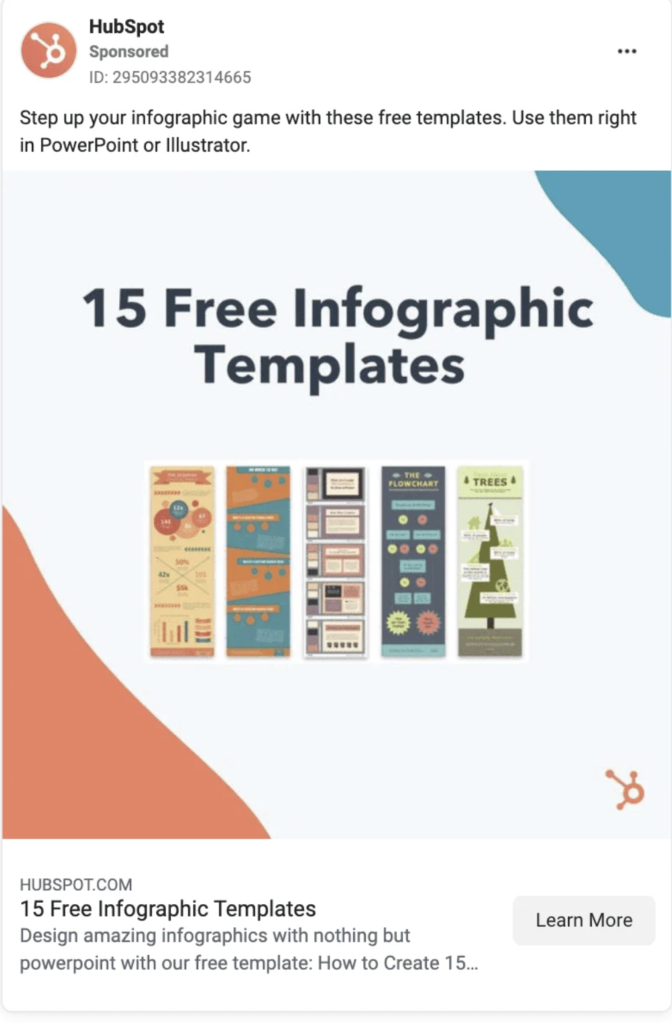
HubSpot’s Facebook retargeting ads are a good example of how to move users forward after they’ve already shown intent.
In this case, the ad is shown to people who have likely visited a product, pricing, or feature page but didn’t convert.
Instead of pushing a demo immediately, the creative offers a relevant lead magnet, “15 Free Infographic Templates,” with a clear, practical use case. The message shifts from broad awareness to reassurance: we’re useful, credible, and worth spending more time with.
The creative itself is simple and familiar. A clean headline, a visual preview of the templates, and a low-commitment CTA (“Learn More”) reduce friction.
This is a common pattern in effective SaaS social media ad formats: meet the user where they are mentally, not where you wish they were. Someone still evaluating doesn’t need a sales pitch: they need value and confidence that the brand understands their workflow.
Why it works:
- The message adapts to evaluation-stage intent
- The offer provides proof of expertise, not hype
- The CTA stays consistent and low-pressure
What to learn: The best SaaS remarketing ads don’t repeat the same pitch. They help buyers progress by offering the next logical step, turning interest into trust, and trust into readiness to convert.
Display Ads Used For Reinforcement
NordPass is a strong example of how display ads can reinforce trust rather than push for an immediate conversion. In publicly documented examples of their advertising, NordPass uses simple banner creatives that foreground credibility signals such as the number of businesses using the product and recognized security certifications like ISO 27001 and SOC 2. The copy is minimal, the visuals are uncluttered, and the message is clear: this is a security product that serious companies rely on.
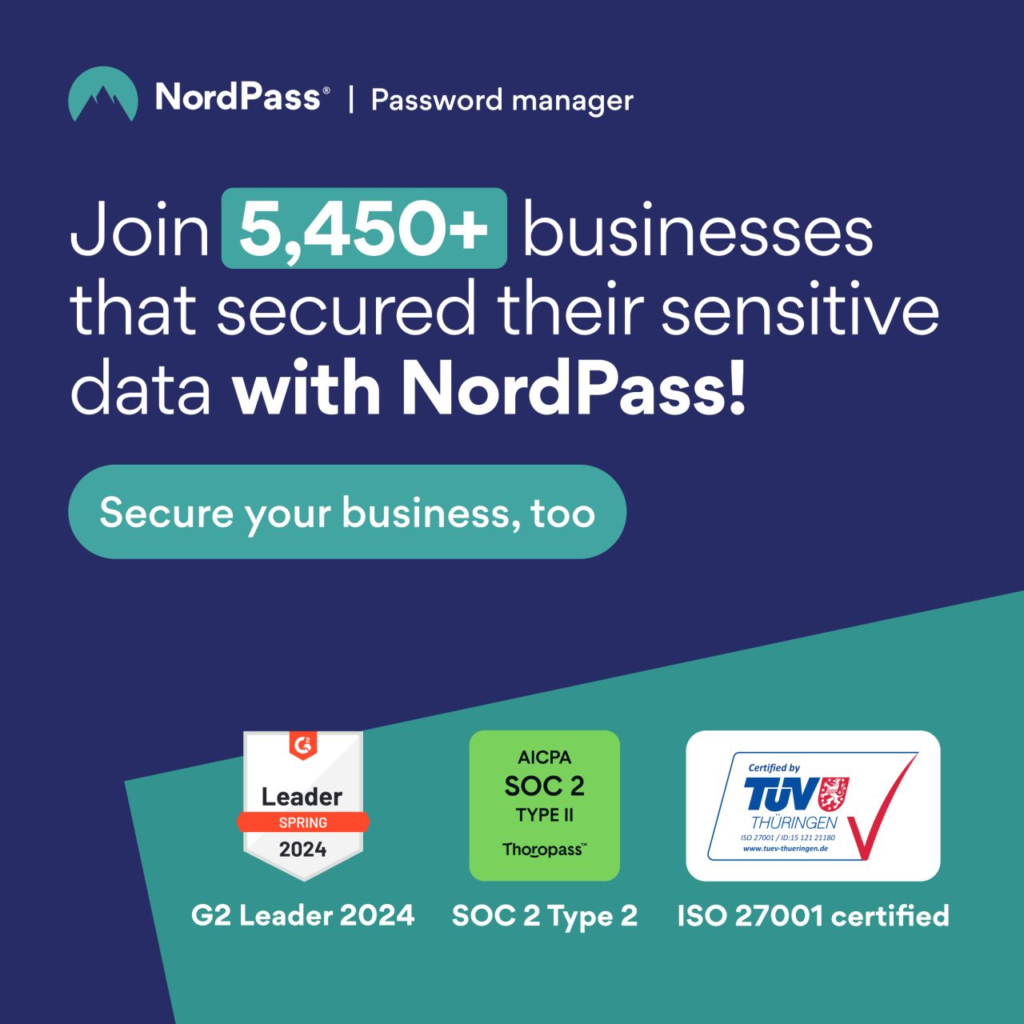
These ads are typically served to warm audiences who have already visited the site or interacted with the brand elsewhere. Instead of reintroducing the product or listing features, the creative focuses on reassurance.
That restraint is intentional. In security-focused categories, buyers are often risk-averse and take time to decide. This is where SaaS display advertising is most effective, not as a demand generator, but as a credibility layer that supports an ongoing evaluation process.
What to learn: Display ads rarely create demand on their own. Used well, they support decisions that are already underway by reminding buyers why a brand feels credible, safe, and worth choosing when the final decision is made.
Lead Magnet Ads For MQL Generation
Intercom has built a strong lead magnet strategy around reports and downloadable content that speak directly to real customer problems, not just email capture. One documented example is Intercom’s Customer Service Trends Report, a data-driven resource that shares insights based on research with customer support teams.
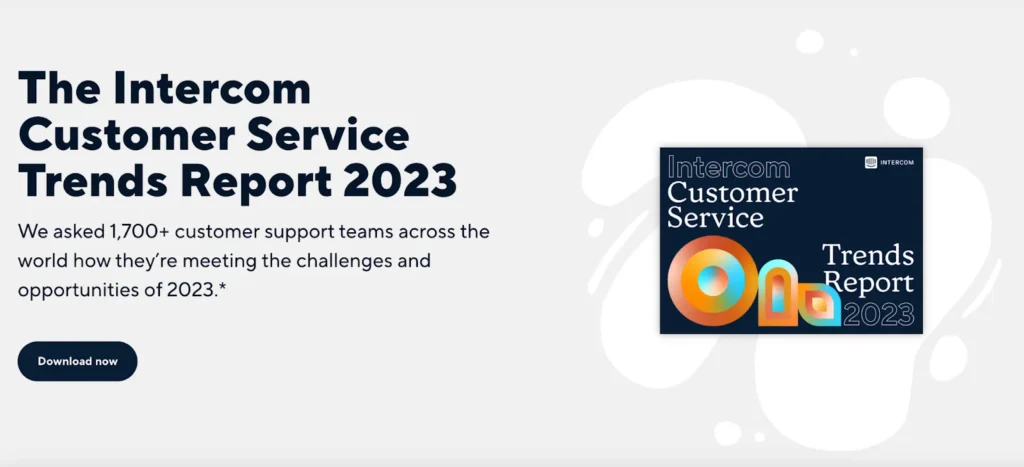
It is positioned as a practical asset for CX leaders and operations teams rather than a generic signup, which immediately signals relevance and intent.
When Intercom promotes resources like this through paid social or search, the creative is clear and benefit-focused.
- The ad tells you exactly what you will get and why it matters to your role. That clarity is what qualifies the lead. Someone willing to download a detailed trends report about customer service is far more likely to be a good fit for Intercom than someone who clicks on a vague offer with no specific outcome.
Why it works:
- High relevance to a defined ICP
- Clear value exchange
- Strong potential for segmented follow-up based on the topic the user engaged with
What to learn: Lead magnets should filter, not inflate. The right offer attracts fewer leads overall, but far more of the right ones, making downstream conversion and sales conversations significantly easier.
Interactive Or Demo First Ads
Figma’s promotion of Figma Make is a strong real-world example of interactive, demo-first advertising done right. Instead of leading with a static message or feature list, the creative drops the user straight into an interactive experience. The ad invites users to design interactive product demos and immediately presents an input field asking what they want to make, with example prompts like onboarding flows or data dashboards. From the first interaction, the product is doing the explaining.
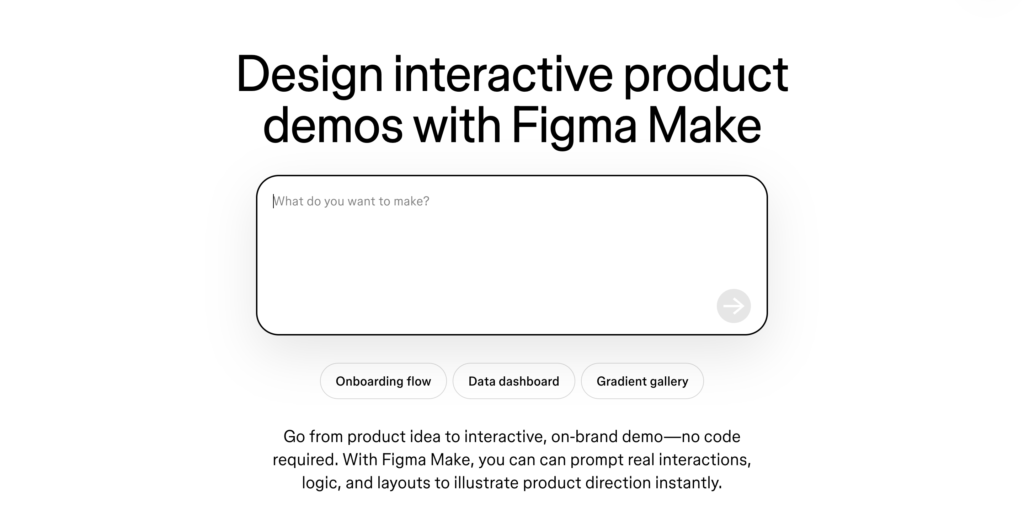
This format naturally self-qualifies users. Someone willing to engage with the interface and explore a use case is already signaling higher intent than someone who just clicks a generic CTA. There’s very little friction, but also no shortcut.
You have to engage to understand the value. That makes this style of Interactive SaaS ads especially effective for complex products where seeing the workflow matters more than reading about it.
What makes it work is the fact that it generates a stronger intent signal, reduces friction by skipping long explanations, and improves lead quality by letting users experience value before converting.
What to learn: Interactivity trades volume for quality. Letting users try before they sign up filters out low-intent clicks and attracts people who are genuinely ready to explore the product.
UGC Style Explainers For B2B SaaS
One real pattern you can spot in effective SaaS advertising is how brands like ClickUp use user-generated content-style videos in paid ads.
These aren’t polished product animations or slick studio spots; they look and feel like someone on a real team talking about how the tool fits into their workflow. In several examples of ClickUp’s social content and ad creatives, users or creators casually highlight specific features like templates or AI workflows, often with a narrative that feels like a colleague showing you a tip rather than a brand selling you a product.
This matters because authenticity outperforms polish in many evaluation scenarios.
A UGC style explainer doesn’t lean on branding or studio production value; it focuses on a real use case, narrated in a conversational tone by a person whose experience feels relatable. That makes the message more credible and easier to trust when someone is already comparing tools or trying to understand how a solution fits their needs.
Why it works:
- Feels credible because it doesn’t look or sound like a traditional ad
- Focuses tightly on a real use case rather than abstract feature claims
- Builds trust quickly because the viewer feels like they’re hearing from someone in their shoes
What to learn: Clarity beats production value. The most effective UGC ads in B2B SaaS make the product understandable by showing it in action through a real voice, not a scripted corporate pitch, a clear advantage for interactive, relatable SaaS social media ad formats.

Creative Patterns That Show Up In High-Performing SaaS Marketing Ads
After looking across search, social, video, display, and retargeting, a few patterns show up again and again. These aren’t platform-specific tricks. They’re fundamentals that tend to sit underneath the best ads for SaaS companies, regardless of channel.
If you’re evaluating or building creative ad formats for SaaS businesses, this is the checklist we come back to most often.
Start With One Clear Outcome
High-performing SaaS ads almost always anchor on a single outcome. Sometimes it’s quantified, sometimes it’s implied, but it’s never vague. “Launch campaigns faster.” “Reduce manual work.” “Improve conversion rates.” When ads try to promise three or four things at once, they usually underperform. One outcome gives the reader something concrete to evaluate themselves against and makes the ad easier to understand at a glance.
Use Proof Early, Not as a Footnote
Social proof isn’t something to hide below the fold. Strong SaaS ads surface credibility quickly through customer logos, short testimonials, industry badges, or a simple metric that signals traction. This doesn’t need to be heavy. Even a single line like “Trusted by 100,000+ teams” can lower skepticism and keep the reader engaged long enough to consider the offer.
Show the Product in Context
Floating UI screenshots rarely explain anything on their own. The ads that perform best show the product doing something recognizable inside a real workflow. That might be a dashboard solving a specific problem, a template being used, or a before-and-after moment that makes the benefit obvious. Context helps the reader connect the product to their day, not just admire the interface.
Call Out a Specific Persona
Generic SaaS messaging usually signals generic results. High-performing ads tend to speak directly to a role, team, or industry. Head of Marketing. RevOps. Product teams. Customer support leaders. When someone feels like the ad was written for them, relevance goes up, and wasted clicks go down. This is one of the most effective but underused SaaS paid media tactics.
Match the CTA to the Buying Stage
The call to action should reflect how much commitment you’re asking for. Demo requests work best when intent is already high. Trials make sense when the product can be understood quickly. Tours, guides, and templates are often better for earlier evaluation. When the CTA doesn’t match the reader’s mindset, it requires even stronger creativity.
Design for Mobile First Reality
Most SaaS ads are consumed on small screens, even when the product is sold to desktop users. High-performing creative accounts for this with readable type sizes, short headlines, and visuals that still make sense when compressed. If the message only works on a large monitor, it’s probably doing too much.
Taken together, these patterns explain why some ads scale while others stall. The goal isn’t to be clever. It’s to be clear, relevant, and aligned with how SaaS buyers actually evaluate products.
Landing Pages Are Part Of The Ad Format
In SaaS, the ad rarely does the conversion. It earns the click, but the landing page decides whether that click turns into a trial, demo, or qualified lead. That’s why ad performance and landing page alignment can’t be separated. When the message, promise, or audience intent changes between the ad and the page, conversion rates drop fast.
The strongest SaaS campaigns keep things tight. The headline reflects the ad copy. The value proposition stays consistent. Friction is reduced by removing unnecessary fields, distractions, or competing CTAs. Proof shows up early, not buried at the bottom. It’s all about reducing uncertainty at the moment someone is deciding whether to move forward.
For your SaaS team, improving landing page clarity and proof will lower CPA more reliably than endlessly tweaking targeting settings. Better alignment often leads to a good ROAS for a SaaS business without increasing spend, simply because more of the existing traffic converts.
The takeaway is simple. If the landing page doesn’t reinforce what the ad promised, the ad format itself is broken, no matter how well it’s targeted.
Measurement That Makes Sense For SaaS Advertising Strategies
Measuring SaaS advertising performance doesn’t need to be complex, but it does need to be grounded in how revenue is actually created. The goal is to understand whether ads are contributing to pipeline quality and long-term growth, not just surface-level efficiency.
- Primary conversion events: Start with the action that moves revenue forward. This is usually a free trial, demo request, or booked sales call. These events anchor your reporting and keep optimization tied to real intent rather than clicks or form fills.
- Pipeline quality and stage progression: Look beyond volume and track how ad-sourced leads move through your funnel. Are they reaching qualified stages, getting accepted by sales, and progressing at a similar or better rate than other channels?
- Customer acquisition cost and payback: Where data allows, track CAC and time to payback for ad-sourced customers. Even directional visibility here helps you decide which formats are scalable and which only look efficient at the top of the funnel.
- Lifetime value, directionally: LTV doesn’t need to be perfect to be useful. Watch for trends in retention, expansion, and churn among customers acquired through different campaigns to spot quality differences over time.
- Incrementality for retargeting and brand: Not every conversion should be treated as incremental. Retargeting and brand ads should be evaluated on lift and influence rather than last-click attribution alone.
- Attribution, kept pragmatic: Use attribution to inform decisions, not to chase false precision. A simple model that helps you compare formats and spot patterns is far more useful than a complex setup no one trusts or uses.
Common Mistakes That Make SaaS Ads Look Busy But Perform Poorly
These are patterns we see repeatedly when SaaS ads generate activity but fail to move the pipeline. They’re easy to miss and expensive to keep running.
- Optimizing for clicks instead of qualified actions: High CTR doesn’t matter if trials don’t activate or demos don’t show up. Clicks are a leading indicator, not a success metric.
- Sending mixed intent traffic to one generic page: Top-, mid-, and bottom-funnel users need different messages. One catch-all landing page usually satisfies none of them.
- Overusing broad targeting without guardrails: Broad reach can work, but only with clear exclusions, messaging discipline, and strong intent signals. Without those, spending drifts fast.
- No negative keyword hygiene: Search campaigns leak budget when irrelevant queries aren’t actively excluded. This is one of the quickest ways performance erodes over time.
- Too many claims, not enough proof: Listing features without evidence increases skepticism. Buyers look for signals they can trust, not promises they’ve heard before.
- No testing cadence: Ads that aren’t tested systematically don’t improve. Without a clear testing rhythm, performance plateaus and teams chase the wrong fixes.
When To Hire A SaaS PPC Agency Like Camel Digital
We’re not here to convince anyone to outsource paid media. We’re just here to help you recognize when external support actually adds value.
If the following points sound familiar, it’s usually a sign you’re ready.
You have product market fit and real budget: You’re past early experimentation. The product sells, customers stick around, and paid media isn’t a gamble; it’s an investment that needs to scale responsibly.
You already run ads, but performance has plateaued: Campaigns are live, but improvements have slowed. CPAs aren’t improving, pipeline contribution is inconsistent, and small tweaks no longer move results.
You need tighter execution and strategy, not more experiments: The issue isn’t a lack of ideas. It’s prioritization, message discipline, and consistent testing tied to funnel stages and intent.
You want a predictable pipeline contribution: Paid media needs to support revenue planning, not just generate activity. Forecastable trials, demos, and qualified leads matter more than isolated wins.
Camel Digital works exclusively with SaaS companies, which means our PPC for SaaS strategies are built around long buying cycles, multi-touch journeys, and real pipeline impact. The focus is on proven playbooks, frequent communication, and close alignment between ads and landing pages. This is where specialisedSaaS PPC services tend to make the biggest difference.
Turn SaaS Ad Formats Into Predictable Pipeline
The biggest takeaway from all of this is simple. The best SaaS ads aren’t chosen because they look good or follow a trend. They’re chosen based on buyer intent, executed with clear creative rules, and supported by landing pages and measurements that actually reflect how SaaS buyers make decisions.
When ad formats, messaging, and offers are aligned to the funnel stage, performance becomes more stable and easier to improve. Clean, creative sets expectations. Landing pages reinforce the promise. Measurement tells you whether the ads are contributing to the real pipeline, not just surface-level activity.
If you’re looking for a practical next step, start small. Audit your current offers by funnel stage and be honest about what each one is trying to achieve. Pick two ad formats that match real intent, not guesswork. Then commit to a real iteration cycle where learning compounds instead of resetting every few weeks.
That’s how SaaS advertising moves from experiments to something predictable and worth scaling.
FAQs
What are the most effective creative ad formats for SaaS businesses?
The most effective creative ad formats for SaaS businesses are the ones that align with buyer intent. High-intent search ads, demo or trial-focused paid social, retargeting ads for evaluation-stage users, and simple video explainers tend to perform best. The common thread is clarity around the outcome and the next step.
Which SaaS advertising strategies work best for generating qualified leads?
Strategies that prioritize intent over volume tend to generate higher-quality leads. This includes search ads targeting evaluation keywords, lead magnet ads that filter for real interest, and retargeting campaigns that move users forward instead of repeating awareness messages. Qualified leads usually come from relevance, not reach.
What types of SaaS ads perform best across digital channels?
Ads that show the product in context and focus on a single outcome perform consistently across channels. Search ads capture demand, paid social drives trials or demos, video ads support understanding, and retargeting reinforces trust. Performance depends less on format and more on how well the message matches the user’s mindset.
How can interactive SaaS ads improve user engagement?
Interactive SaaS ads let users experience value before committing, which raises engagement and intent. Demo-first or interactive formats self-qualify users by requiring participation. This reduces low-quality clicks and improves lead quality, even if overall volume is lower.
What are the best social media ad formats for SaaS companies?
The best social media ad formats for SaaS companies are usually simple and direct. Single-image or short video ads with a clear benefit, low-friction CTA, and role-specific messaging tend to outperform complex creatives. Social works best when the value is obvious within seconds.
How should SaaS brands structure their remarketing ads for maximum ROI?
Remarketing ads should reflect what the user has already done. Evaluation-stage visitors respond better to reassurance, proof, and helpful next steps than repeated sales pitches. Structured correctly, remarketing supports decision-making and improves ROI by converting existing interest rather than forcing new demand.