If you have a working SaaS email marketing strategy, you already have one of the simplest ways to build long-term value from your customers. These patterns are what shape most SaaS email marketing campaigns, making them easier to plan, test, and scale over time. Email gives you a direct, low-cost way to guide customers through your product and keep them engaged over time.
Good SaaS email marketing is less about sending more emails and more about sending the right one at the right moment.
When timing or messaging is off, results drop quickly. That’s why many teams think email doesn’t work for SaaS, while in reality, it works if you know how to use it.
What is SaaS email marketing?
SaaS email marketing is how SaaS teams guide users through the marketing funnel using behavior-based messages. It supports onboarding, feature discovery, usage reminders, feedback, renewals, and expansion. Each message exists because of something the user did or did not do.
Day 1
“Hi Emma, thanks for signing up. This quick walkthrough will help you take your first steps. If you have questions, you can always reach us.”
Day 5 (after user is inactive)
“Hi Emma! we noticed you haven’t been active recently. If anything slowed you down, our support and help tools are ready whenever you are.”
These emails do not sell anything. They do not push offers.
They simply show up at the right time. Writing them takes little effort, but they help users stay confident and avoid churn caused by confusion, not lack of interest. That matters, especially when the company already invested time and money to bring the user in.
This is what SaaS email marketing looks like in real life.
Why is email marketing for SaaS still important?
Few channels offer the kind of return email does, with results often exceeding $36 for every $1 spent.
For teams working with long sales cycles and high acquisition costs, that level of SaaS ROE is hard to ignore. It explains why email is still relevant, even as new channels promise faster wins.
- Email works because it feels personal without being intrusive. It lives in a space users already trust for updates and communication. Messages arrive in a familiar place and reflect what users have already done. That makes email especially effective for long-term relationships, which SaaS depends on.
- Throughout the SaaS marketing funnel, email supports progress in small, practical steps. Early on, it supports lead capture and trial onboarding. As users progress, it helps explain features, communicate value, and keep users engaged. This is why email works equally well for both product-led and sales-led growth models.
- Measurement also plays a key role. Email performance is easy to connect to real behavior, which helps teams understand true ROAS for SaaS. Teams can tie email performance to real outcomes like feature usage and renewals, rather than surface metrics.
- Most importantly, SaaS email marketing helps prevent churn. Users often churn because they lose direction, not interest. Email helps maintain that direction by offering timely guidance and reminders. Over time, this steady support helps users stay engaged and see long-term value.
Top 9 SaaS email marketing strategies
Luckily, the SaaS industry, while complex on the surface, follows a few very predictable patterns once users enter the product.
Most users hesitate at the same steps, delay the same actions, and look for clarity at the same moments. That’s why a set of proven strategies exists that make email marketing for SaaS work for most companies.
We’ve documented them below.
1. Cold emailing for acquiring new SaaS customers
- When to do it: When your SaaS needs demand from outside its existing traffic and network.
- Who to target: Roles that already experience the problem and don’t need it explained from scratch.
- Why do it: To create first contact and learn which segments actually respond.
Cold email marketing for SaaS is often the first way SaaS companies reach prospects who have never heard of the product. At that stage, there is no awareness and no intent, which is exactly why email works better than most channels. It allows direct contact without waiting for demand to form.
This also means that you should be very prepared for your first conversation with a potential user. Before writing anything, you need to be clear about who you are reaching and why this message makes sense right now.
Many campaigns struggle because they try to speak to several roles or situations at once. A message written this way rarely feels specific to anyone. Focusing on one role and one real scenario improves results because the email matches the reader’s reality.
For example, an email written for “marketing and sales teams” usually stays vague so it can apply to both. An email written only for a SaaS marketing manager who struggles with trial drop-off can be direct and familiar.
In email marketing for SaaS companies, cold email is about starting a useful conversation. Once that happens, onboarding, activation, and lifecycle emails can do the rest.
2. Drip campaigns for nurturing long SaaS sales cycles
- When to do it: When leads show interest but are not ready to buy and need time to evaluate the product.
- Who to target: Trial users, demo viewers, and leads who signed up but paused before a decision.
- Why do it: To stay present during long decision cycles without pushing or overwhelming.
Once users arrive through cold email or other channels, most do not convert right away. They explore a demo, start a free trial, or join an email list. At this stage, silence often leads to drop-off, while too many messages cause fatigue. Well-designed drip campaigns help manage that balance.
Good drip campaigns are not random sequences. They are built around how potential and existing users usually evaluate your solution and behave at different stages of the decision process. Each message should have a clear purpose tied to where the user is in the journey. Timing matters as much as content.
That’s why good drip campaigns are based on deep research and robust CRM data. You need to understand common delays, questions, and blockers within your user base.
When those are mapped correctly, it becomes easier to design automated emails that feel supportive rather than intrusive.
3. Onboarding email sequences that help users feel at home in the product
- When to do it: When a user signs up, starts a trial, or makes a first purchase and is most open to learning.
- Who to target: New users who are seeing the product interface for the first time.
- Why do it: To help users move from curiosity to confident daily use and avoid early churn.
Starting with a new SaaS product is almost always a mental shift. Big or small, every tool asks users to trust a new interface and imagine moving part of their work or data into it. That moment is fragile. If things feel unclear, users get frustrated quickly.
This is why SaaS companies shouldn’t overlook onboarding email sequences. They support the first days when motivation is high but understanding is still low. Good sequences mix small wins with clear explanations. They create early “aha” moments, set expectations, and point users to help before confusion builds.
The best onboarding emails balance emotion and structure. A warm welcome creates comfort. Clear feature guidance creates confidence. Well-placed support links reduce friction. When done right, users don’t just try the product. They begin to imagine it as part of their routine, and over time, it becomes one.
4. Feature adoption emails that turn interest into regular use
- When to do it: When users are active but not yet using the features that show the product’s real value.
- Who to target: Users who completed basic actions but haven’t explored deeper or newly released features.
- Why do it: To help users discover features that solve real problems and keep them engaged.
Most SaaS users don’t explore every feature on their own. They stick to what they already understand and ignore the rest. Feature adoption emails guide attention to the parts of the product that matter most at the right time.
The key is being selective. Not every feature needs promotion. Focus on those that remove friction, save time, or clearly improve results. New launches work best when they are tied to a familiar problem the user already has.
Timing matters here. Feature emails perform best when triggered by behavior or usage gaps. When a feature matches a current need, it feels helpful instead of distracting. Done well, these emails increase activation, strengthen habits, and support long-term retention.
5. Behavior-based drip campaigns triggered by real product usage
- When to do it: When users show clear usage patterns or inactivity that signal a specific need.
- Who to target: Active users, paused users, or users stuck at a certain feature stage.
- Why do it: To respond to what users actually do instead of guessing what they might need.
The previous strategy of feature adoption emails starts from what you want users to try. Behavior-based campaigns work from the opposite direction. They start from what the user already did or didn’t do inside the product.
For example, if a user sets up a project but never invites a teammate, a short email can explain why collaboration matters and how to add others. If a user stops logging in after using one feature repeatedly, an email can suggest a next step that builds on what they already understand.
SaaS email marketing automation makes these campaigns possible by turning user actions into timely, personalized messages. Triggers based on usage or inactivity allow emails to feel timely and relevant without increasing volume.
6. Milestone emails that reinforce progress and loyalty
- When to do it: When users reach meaningful moments such as usage milestones, anniversaries, or key achievements.
- Who to target: Active users who have invested time or data into the product.
- Why do it: To reinforce progress and strengthen long-term attachment to the product.
Milestone emails are often seen as emotional touches, but their value goes beyond that. They help users pause and recognize progress they might otherwise overlook.
For example, an email that highlights “30 days active” or “first 10 projects completed” reminds users that the product is already part of their routine, reducing risks of churn. Another example is marking a one-year anniversary with a short recap of what they’ve achieved using the tool, boosting connection with the product.
With milestone messages, email marketing for SaaS supports retention subtly. By showing users what they’ve built and improved, the product feels harder to replace.
7. Ongoing retention emails that support long-term relationships
- When to do it: When you want to reduce churn by keeping the relationship warm between onboarding, major updates, and renewal.
- Who to target: Active customers and partially active customers who may not raise issues but can quietly drift away.
- Why do it: To make renewal feel like a natural continuation and prevent billing surprises from becoming a reason to leave.
SaaS businesses live on repeat relationships. A customer rarely makes a single decision and then forgets about it. Instead, they keep deciding, month after month, whether the product still deserves a place in their workflow. That’s why retention can’t rely only on triggers, alerts, or last-minute reminders. It needs a steady email strategy.
Ongoing retention emails focus on continuity. They remind users why the product matters, how it supports their goals, and what value they are getting over time. These messages don’t need a specific action to be sent. Their job is to keep the relationship familiar, so the product never feels distant or easy to drop.
Renewals should be treated as a decision point, not just a billing event. You should start conversations about renewals earlier than the renewal date. Emails sent 90, 60, and 30 days before renewal give users time to reflect, ask questions, and feel in control of the situation, rather than being charged out of nowhere.
Retention emails should mix reassurance with clarity, including a short note on progress, a simple snapshot of usage, and a calm reminder of what happens next.
Remember that in SaaS, churn often starts with silence. Users usually don’t complain about a specific issue. They just slowly disengage and leave at some point. So make retention emails part of your ongoing SaaS email strategy to keep users engaged continuously.
8. Re-engagement emails for users who paused or left
- When to do it: When retention efforts didn’t work and a user paused a subscription, canceled, or deleted their account.
- Who to target: Recently churned users whose context, data, and past usage still make a return realistic.
- Why do it: To reopen the relationship, understand what went wrong, and give users a clear reason to come back.
If ongoing retention emails fail and a user still drops, this is where re-engagement campaigns should step in. At this stage, SaaS businesses usually shift focus. The goal is no longer short-term revenue but winning the customer back and restoring trust.
A strong re-engagement SaaS email marketing strategy is built around flexibility. That can mean offering a temporary discount, extending a trial, unlocking features for a limited return period, or removing friction that previously caused frustration. These options should be prepared in advance, not improvised after churn happens.
Equally important is feedback. The moment a user leaves is the clearest signal you’ll get. A short, respectful email asking why they left often delivers more insight than months of usage data. When collected and reviewed properly, this feedback shows patterns in product gaps, pricing issues, or onboarding failures.
For email marketing for SaaS companies, re-engagement emails are not about pressure. They are about listening, learning, and offering a realistic path back. Even when users don’t return, the insight they leave behind helps improve every stage of the funnel that comes before.
9. Upsell emails that support expansion without pressure
- When to do it: When users are actively using the product and approaching limits or advanced needs.
- Who to target: Active accounts with regular product usage, growing teams, or increasing complexity in their workflows.
- Why do it: To turn satisfied customers into long-term, higher-value accounts by offering clear next steps.
Turning healthy accounts into power accounts is one of the most direct strategies for SaaS to increase revenue from the same user base. The best targets for upsell emails are users who reach a limit, adopt a feature heavily, or manage more data than their current plan.
Upsell emails connect those signals of growth readiness to a solution for the user. For example, you can point out that a user has reached a reporting cap and explain how a higher plan removes friction and saves time. The message frames the upgrade as a natural continuation of how the product is already being used.
Emails tied to real usage feel relevant and timely. Case studies or short peer benchmarks can also help, especially for decision-makers who want reassurance. Seeing how similar teams benefit from an upgrade reduces hesitation without pushing urgency.
When expansion is positioned as added value, not a sales move, users are more likely to see the upgrade as an investment rather than a cost.

How to do email marketing for SaaS
SaaS email marketing looks complex from the outside, but strong results usually come from a small set of well-thought-out, repeatable actions.
Your core need is to understand your users well enough to send the right message at the right moment without overthinking tools or volume.
Step 1. Define the strategy
Most SaaS email strategies look very similar at the core. Around 70 to 80% of the structure is shared across most SaaS products because user journeys tend to follow the same path.
People sign up, try the product, look for early value, decide whether to stay, and eventually renew or grow their usage. That’s why the first step is to define the main building blocks of your strategy.
Start by outlining the standard email flows that almost every SaaS relies on:
- Trial and onboarding emails
- Activation and early usage emails
- Feature adoption emails
- Retention and renewal emails
- Expansion and upsell emails
Then add product-specific flows based on how your SaaS works and how your users behave.
If your product has unique setup steps, a specific audience, or a narrow use case, those differences should show up in your emails.
For example, you may need a flow that helps users connect a data source, upload their first file, invite teammates, or complete a setup step that is critical for seeing value. If your users come from different roles or industries, you may also need separate flows that speak to those differences.
Once these flows are clear, think of each one as its own small journey. Each flow should have:
- a clear audience
- a clear outcome
- and a clear moment when it begins and ends.
Content, tone of voice, timing, and frequency of emails naturally fall into place when the above points are clear. You already have the skeleton. It’s time to add life to it.
Step 2. Collect contacts
Every SaaS email marketing strategy starts with having the right people in the right place. You don’t need one big list. You need separate lists for each email flow, built with intention and kept clean over time. Each of your SaaS email marketing flows needs its own audience.
- Most of these contacts come from predictable sources. Sign-up forms, free trials, demo requests, gated content, and in-product prompts all work when they appear at moments when users already expect follow-up. Connecting these touchpoints with your CRM helps keep context intact and avoids messy handoffs later.
- Once contacts enter your system, segment them by lifecycle stage, persona, or behavior for more relevant messaging. At a minimum, you should know where the user is in their lifecycle.
Things work differently with cold email because you are reaching people who are not yet part of your user base. Since there is no prior relationship, the quality of the list becomes the starting point of the whole process.
To build that list, first decide which roles are most likely to face the problem your product solves. Once the role is clear, narrow the list by company size, industry, or tools they already use, so the context stays consistent. This makes the message easier to write and easier to recognize.
LinkedIn research and trusted data providers work well at this stage because they help keep targeting accurate.
If you want to go deeper into attracting the right users before email even begins, you can also read our SaaS lead generation tips.
Step 3. Create and send content
The golden rule of effective email is simplicity. Strong emails are easy to scan, easy to understand, and easy to act on. A few principles guide almost every message that works well in SaaS:
- Emails should be short and go straight to the point so users understand the purpose within the first few seconds.
- Subject lines should clearly reflect what the email is about and invite the user to open it without sounding vague or forced.
- Each email should communicate one main idea and focus on one clear action, so users know exactly what to do next.
Once this foundation is in place, relevance becomes the next priority, and this is where SaaS email marketing automation becomes essential. Email copy should always match the role of the reader, their stage in the journey, and how they currently use the product. A message written for a first-time trial user should sound very different from one written for an experienced customer.
This alignment is what makes emails feel natural. When the message reflects what the user is already thinking about, it blends into their workflow rather than competing for attention. Over time, this approach builds trust as users come to expect emails that help them move forward.
Polish your email content based on open and engagement rates. It takes time and patience to reach a point where you are confident in your email. The good news is that once you find messages that work well, they become evergreen building blocks you can reuse across your email strategy.
Step 4. Analyze results
A/B testing and regular analysis should be part of how you work with email. Testing different subject lines, timing, or message structure helps you understand what works for your audience. This becomes especially important when open rates drop or clicks don’t lead to real actions inside the product.
You should never evaluate email performance in isolation. Opens and clicks only matter if they lead to something meaningful, such as conversions or signups, etc. That means tracking what users do after they engage with an email is essential. Do they activate a feature, return to the product, upgrade, or move closer to renewal?
To do this well, you need clear tracking in place. Use trackable links, consistent attribution rules, and product analytics that connect email activity to user behavior. This gives you a full picture of how emails influence retention, usage, and revenue.
Great SaaS email marketing examples of the last year
Here are examples of what good SaaS emails look like when they are done right.
Notion
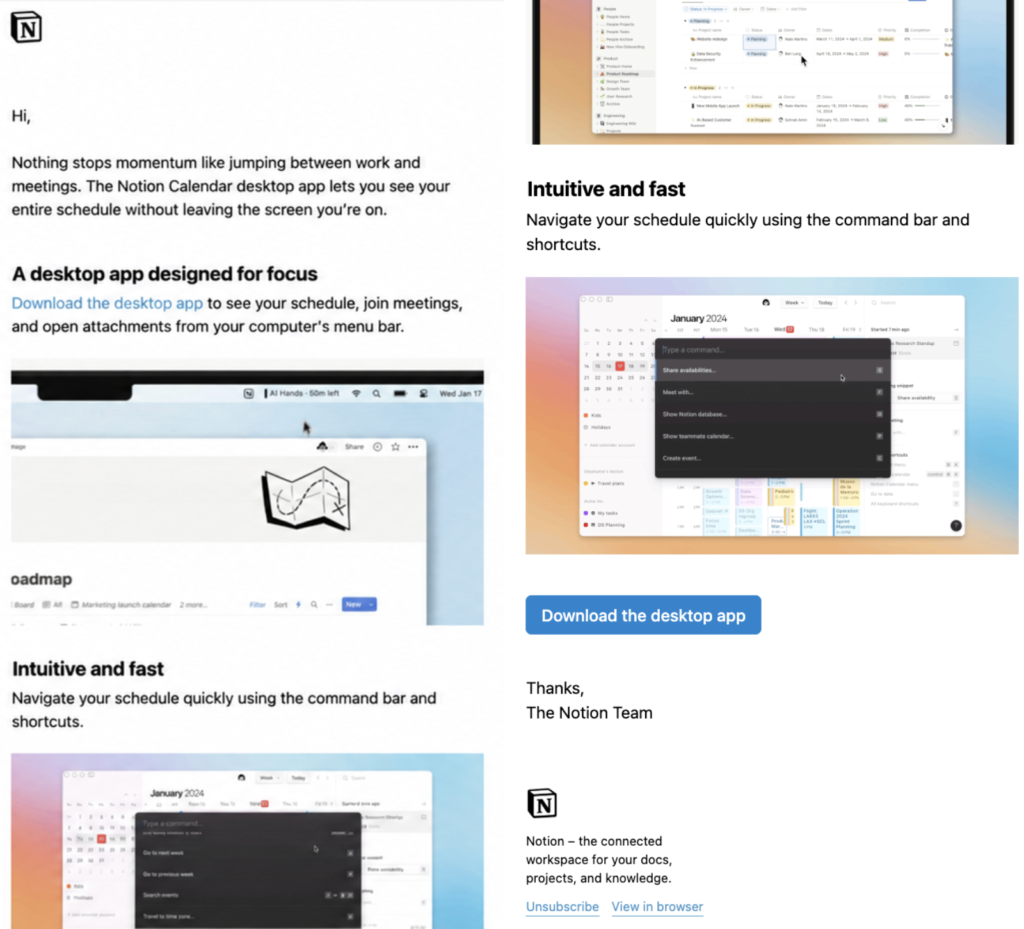
Notion’s email works because it turns a product update into a clear workflow improvement. Instead of only announcing the desktop app, the message explains how it helps users stay focused, check their schedule, join meetings, and open attachments without leaving their current screen. That makes the email useful because the feature is tied to a real daily problem, not just product news.
Grammarly
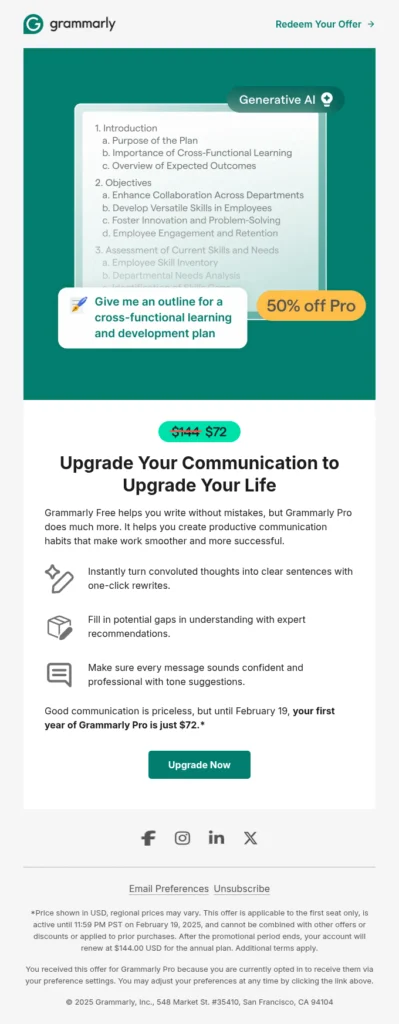
This email ties the upgrade offer directly to visible value. The email shows how Pro improves real tasks the user already cares about, adds a clear incentive with a time-bound discount, and keeps one clear CTA. The message feels relevant, practical, and easy to act on without overexplaining.
Slack
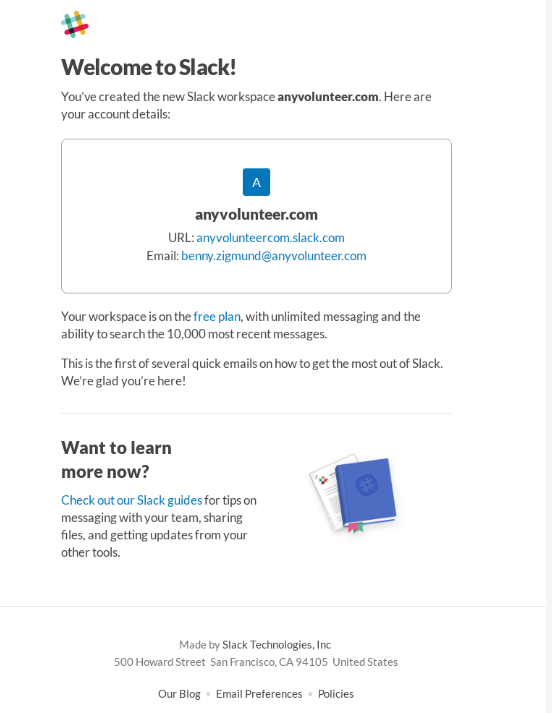
Slack takes a different approach here, which is why it works. This email focuses on orientation, not promotion. It confirms setup, removes uncertainty, and clearly sets expectations for what comes next. In email marketing for SaaS, this kind of calm onboarding message helps users feel grounded and ready to engage, instead of overwhelmed or pushed.
Canva
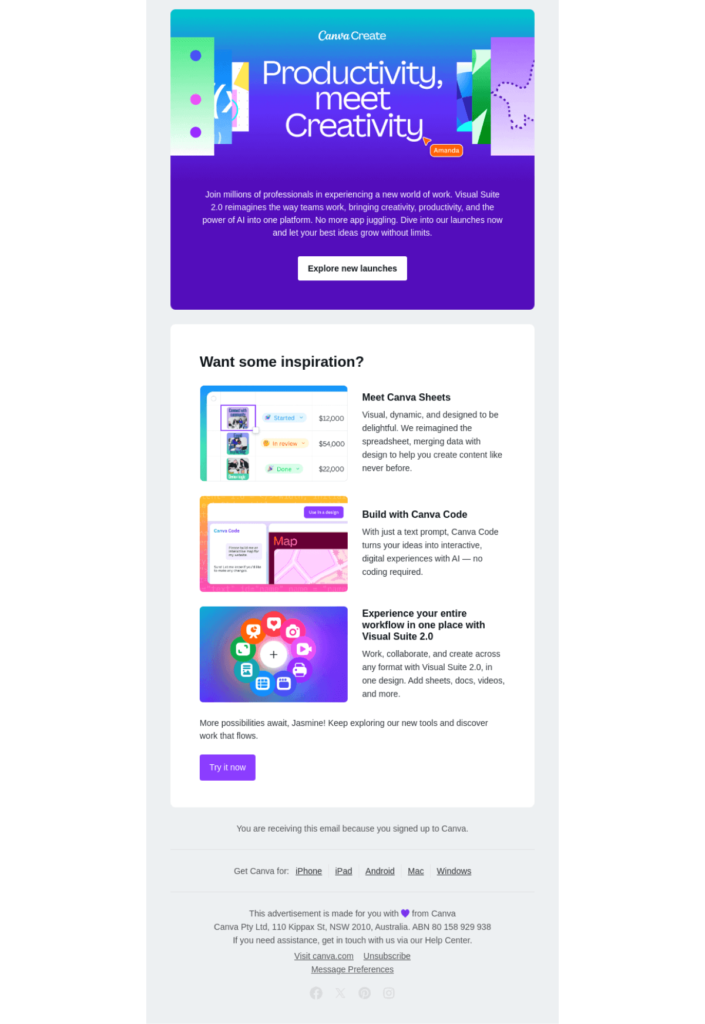
Canva uses this email to spark curiosity rather than explain everything at once. It introduces new features through visuals and short descriptions, letting users explore at their own pace. The message feels inspirational, not instructional. By showing possibilities instead of steps, Canva nudges users to try more tools and deepen usage without pressure.
Loom
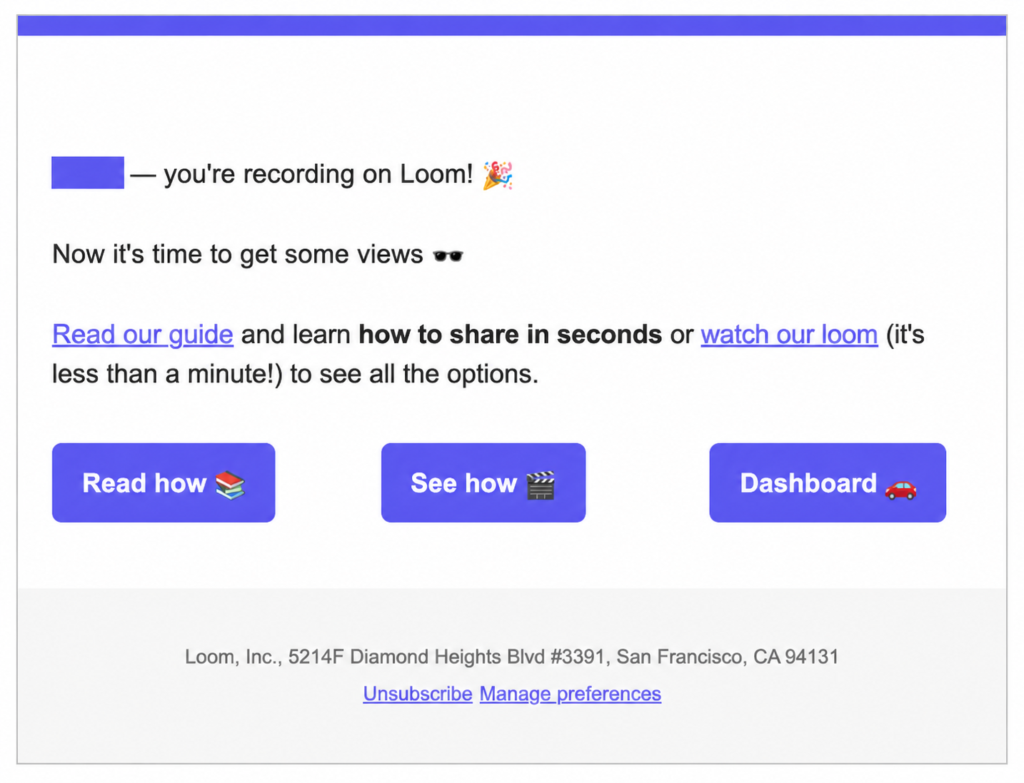
Loom uses this email to guide users right after an early product milestone. Once the user starts recording, the message shifts attention to the next step: sharing the video and getting views. That makes the email feel useful because it matches what the user is likely thinking about at that exact moment.

Why a solid SaaS email marketing plan matters in 2026
Email keeps working in SaaS because it stays close to how products are actually used. While tools and channels change, email remains one of the easiest ways to adjust messaging as user behavior, features, and pricing evolve.
Strong teams don’t treat email as a setup task. They treat it as a living system. Messages are refined as users hesitate, progress, or change how they use the product. That ongoing alignment is what keeps email effective long after launch.
If you want to build this kind of system faster and with fewer blind spots, it can help to work with SaaS-focused email marketing services like Camel Digital, where strategy and product behavior come first. This is where SaaS email marketing services can help, especially when internal teams lack the time or structure to build and manage these systems effectively.